Monday, January 15, 2007

Planet of Slums

When I first opened Mike Davis' Planet of Slums, I expected to neither enjoy nor finish reading it, because the typeface just screamed “boring academic tome by someone who couldn't write an clean and elegant sentence to save their lives.” Mercifully, I was wrong. Mike Davis can write well—even though he does tend to the overly-complex sentence with a plethora of sub-clauses. But the thing that lifted this book out of the ordinary for me was sense of barely-contained rage behind almost every line.

Also shocking was that here was an American writer willing to engage in a Marxist analysis of a phenomenon. One could turn each page and run into quotes like this:

[The] constant effort [of NGOs] is to subvert, dis-inform, and de-idealize people so as to keep them away from class struggles. They adopt and propagate the practice of begging favours on sympathetic and humane grounds rather than making the oppressed conscious of their rights. As a matter of fact these agencies and organizations systematically intervene to oppose the agitational path people take to win their demands. Their effort is constantly to divert people's attention from the larger political evils in imperialism to merely local issues and so confuse people in differentiating enemies from friends.”

P.K. Das, “Manifesto of a Housing Activist,” in Patel and Thorner, Bombay, pp.179-180
Mike Davis, Planet of Slums, London, Verso 2006 p. 78


There is a tremendous level of scholarship and research in this book, but leavened with anger and outrage, it seldom becomes boring or purposeless. Davis has a lot to convey, and a point of view that gives the information context and relevance. I confess that a lot of this book struck me as new information—which is absurd, since there is not a lot that is new here. But worldwide poverty and the expansion of slums has fallen off the radar of most of the developed world. We have, after all, more important things to worry about; peak oil, Gulf War II, rising levels of consumer debt in the US and what that means for the stock market—stuff like that. That there are poor people, homeless people, and dying people just doesn't seem that important, somehow. After all, they're useful for keeping global wage inflation down. Other than that, they really don't exist, do they?

Davis knows they exist, and that the problem is exploding; “Residents of slums, while only 6 percent of the city population of the developed countries, constitute a staggering 78.2 percent of urbanites in the least-developed countries; this equals fully a third of the global urban population.” (p.23) But really, what does this matter? Slum dwellers, by definition, don't matter. They're unimportant, un-engaged, and unnecessary. Well, except for that anti-wage-inflation thing, right? Davis doesn't think so: “Indeed, the future of human solidarity depends upon the militant refusal of the new urban poor to accept their terminal marginality within global capitalism.”(p.202) And terminal marginality is right. According to The World Distribution of Household Wealth by the World Institute for Development Economics Research of the United Nations University (UNU-WIDER):

The most comprehensive study of personal wealth ever undertaken also reports that the richest 1% of adults alone owned 40% of global assets in the year 2000, and that the richest 10% of adults accounted for 85% of the world total. In contrast, the bottom half of the world adult population owned barely 1% of global wealth.

And if that's not unequal enough, the inequality in the distribution of world wealth, if world wealth was reduced to $100 and world population to 10 people, means that one person would have $99 and the rest would be fighting over the last dollar. Surprisingly, household debt is relatively unimportant in poor countries. As the authors of the study point out: “While many poor people in poor countries are in debt, their debts are relatively small in total. This is mainly due to the absence of financial institutions that allow households to incur large mortgage and consumer debts, as is increasingly the situation in rich countries.” The authors go on to note that ‘many people in high-income countries have negative net worth and—somewhat paradoxically—are among the poorest people in the world in terms of household wealth.’ ”

The absence of financial institutions may be slight solace to poor households around the world. Subtracting debt from assets and coming up positive rather than negative isn't quite the same thing when the positive is $2 and the negative means that you have a house, car, food and a job, and you're just carrying a load of debt on a thirty-year payback cycle.


(As a side note: I read recently where car companies hate the whole “no down payment, first year interest free” marketing for car sales. But they can't stop it, because most of their customers couldn't come up with a down payment. They simply don't have the money. So in order to keep the whole Ponzi scheme running, incentives have to be offered. Now it seems that banks are having to follow suit, and are offering mortgages calculated on a forty-year payback cycle, rather than twenty or twenty-five. This keeps the monthly payments low enough on the inflated house values that more people can handle them. It also proves to be very lucrative for the banks—it takes that much longer for any impact to be made on the principal owed. Ponzi was a funny guy....)

Davis notes this inequity as well. After how many? decades of neoliberal policies; “If UN data are accurate, the household per-capita income differential between a rich city like Seattle and a very poor city like Ibadan is as great as 739 to 1 – an incredible inequality.” [emphasis in original](pp. 25-26) It's not just about money. The speed at which the planet has been urbanizing is extraordinary as well. Davis composed this table showing the growth of megacities (megacities are those with a population of 8 million or more. Hypercities have populations over 20 million) in the last fifty years or so:

Third World Megacities

(population in millions)


1950

2004

Mexico City

2.9

22.1

Seoul-Injon

1.0

21.9

(New York)

12.3

21.9

São Paulo

2.4

19.9

Mumbai

2.9

19.1

Delhi

1.4

18.6

Jakarta

1.5

16.0

Dhaka

0.4

15.9

Kolkata

(Calcutta)

4.4

15.1

Cairo

2.4

15.1

Manila

1.5

14.3

Karachi

1.0

13.5

Lagos

0.3

13.4

Shanghai

5.3

13.2

Buenos Aires

4.6

12.6

Rio de Janeiro

3.0

11.9

Tehran

1.0

11.5

Istanbul

1.1

11.1

Beijing

3.9

10.8

Krung Thep (Bangkok)

1.4

9.1

Gauteng (Witwatersrand)

1.2

9.0

Kinshasa / Brazzaville

0.2

8.9

Lima

0.6

8.2

Bogotá

0.7

8.0

from Mike Davis, Planet of Slums, London, Verso 2006

The cancerous growth of cities around the world is matched by the growth of their attendant slums:

Largest Slum Populations by Country


Country

Slum % urban pop.

Number (millions)

China

7.8

193.8

India

55.5

158.4

Brazil

36.6

51.7

Nigeria

79.2

41.6

Pakistan

73.6

35.6

Bangladesh

84.7

30.4

Indonesia

23.1

20.9

Iran

44.2

20.4

Philippines

44.1

20.1

Turkey

42.6

19.1

Mexico

19.6

14.7

South Korea

37.0

14.2

Peru

68.1

13.0

USA

5.8

12.8

Egypt

39.9

11.8

Argentina

33.1

11.0

Tanzania

92.1

11.0

Ethiopia

99.4

10.2

Sudan

85.7

10.1

Vietnam

47.4

9.2

from Mike Davis, Planet of Slums, London, Verso 2006


These are phenomenal growth rates. The countryside is being depopulated and people are breeding at rates that would make Malthus blanch. How do people get fed, how do they find work, where do they live, when they are showing up in the city at such speed? It's no wonder that municipal services—even in developed countries—are being overwhelmed. There are just too damned many people. Revolutions take strange local forms, but class struggle is always based in perceived inequity. The explosion of slums and the concomitant formal or informal expropriation of rural land, and the seemingly genetically-encoded pull cities have on people, engender resentment in those tied to the land. “Outside Hanoi, where farmers and fishermen are constantly uprooted by urban development, urban and industrial effluents are now routinely employed as free substitutes for artificial fertilizers. When researchers questioned this noxious practice, they discovered “cynicism among vegetable and fish producers” about the “rich people in cities.” “They don't care about us and fool around with useless compensation [for farm land ], so why not take some form of revenge?” (pp. 135-136)

“Rich people in cities” is, of course, a relative “rich”: “Residents of slums, while only 6 percent of the city population of the developed countries, constitute a staggering 78.2 percent of urbanites in the least-developed countries; this equals fully a third of the global urban population.” (p.23) So the “rich people in cities” are living on unserviced lots, most likely without access to fresh or clean water, or even marginally functional sewage systems. And they are living on under two dollars a day, often on less than one. Compared to the developed world, “the number of urban poor is considerably greater: at least one half of the world's urban population as defined by relative national poverty thresholds. [emphasis mine] Approximately one quarter of urbanites (as surveyed in 1988), moreover, live in barely imaginable “absolute” poverty – somehow surviving on one dollar or less per day.” (p.25)

One dollar or less a day. Davis quotes studies that show that there is no corresponding increase in wealth with the increase in slum populations. Indeed, every new “self-employed” person simply chops the available market up into ever-finer pieces. There is no “growth,” no “expansion.” There is only the same dollar being shared between more and more people. This is the situation that micro-credit institutions like the Grameen Bank were developed to address . But, as Davis points out;

[U]nder such [desperate] conditions, it is not surprising that initiatives such as micro-credit and cooperative lending, while helpful to those informal enterprises managing to tread water, have had little macro impact on the reduction of poverty, even in Dhaka, the home of the world-famous Grameen Bank. Indeed , stubborn belief in “leveraging the micro-enterprise,” writes Jaime Joseph, a veteran community organizer in Lima, has become something of an urban cargo cult amongst well-meaning NGOs: “There has been much emphasis placed on small or micro-enterprise as the magic solution in offering economic development for the urban poor. Our work over the last 20 years with small businesses, which are multiplying in the megacity, shows that most of them are simply survival tactics with little or no chances for accumulation.”

Mike Davis, Planet of Slums, London, Verso 2006 pp. 183-184

Helpful, but with little impact on poverty reduction. Here in the developed West, the “Nike effect” of globalization is touted as the salvation for the poor of the world. We will export working class jobs to the Third World (beggaring our people, but keeping that all important anti-wage-inflation effect in place), where grateful coolies will make our consumer goods for pennies on the dollar, improving their lives while providing us with low cost consumer goods. This is called “win-win.” But “under such extreme conditions of competition, the neo-liberal prescription (as set out in the World Bank's 1995 World Development Report) of making labor even more flexible is simply catastrophic.” (p. 185)

“Flexible” here means low wages, high unemployment, and no workplace protections for labour. Keeping the desperation level high keeps labour costs low. Classic neoliberal thinking. It is a mode of thought that is dedicated, despite its rhetoric, to keeping things bad, to expanding the population of the truly poor, and to making the rich richer. Which, viz. the WIDER report above, is working very well.

[...][E]verywhere obedience to international creditors has dictated cutbacks in medical care, the emigration of doctors and nurses, the end of food subsidies, and the switch of agricultural production from subsistence to export crops. As Fentu Cheru, a leading expert on debt, emphasizes, the coerced tribute that the Third World pays to the First World has been the literal difference between life and death for millions of poor people.

Mike Davis, Planet of Slums, London, Verso 2006 p.148


This also means that countries like Canada have been offloading a lot of costs to the Third World, and creaming a lot of benefits. Like the above-mentioned doctors. Where do they emigrate to? Countries like Canada, where, in desperation, trained professionals take lower rates of pay to perform work that would otherwise go towards the improvement of life in the Third World. In order that more of our people can get their stomachs stapled, hundreds or thousands must die in other countries. One can only be reminded of Ursula K. LeGuin's short story “The Ones Who Walk Away From Omelas.”

The question of how to house and service the world's poor is one that has occupied the World Bank, architects, and theorists of all stripes for more than a century. Davis draws frequent parallels between Victorian England and current thinking on the worldwide explosion of slums. Typically we see slum clearance as one of the primary means of addressing the problem of city-based poverty. But too often, that is where the thinking stops; clear the slum and drive the inhabitants out, and all will be well. The necessary follow-up of social housing, improved services, training, welfare and lowering unemployment are all seen as too expensive, as money wasted on the poor. All we really want (and this is particularly evident in the current war against “public sleeping” in Victoria) is to not see the poor and homeless. And if we don't see them, then there is no problem to worry about. It's when these horrible excuses for people interfere with our lives, when we have to step over them or decide whether or not to give them some change, when we have, in short, to think about them, that we feel most put upon.

This is why our local governments (which have evolved over the last century to meet the needs of developers rather than citizens) tear down “tent cities” and other examples of colloquial housing. The visibility of the poor, the marginalized, the homeless depresses property values and may awaken a social conscience. Tent cities are cleared; services aren't provided, relocation is never pursued, the issues are never dealt with. Heaven forbid that “the oppressed [become] conscious of their rights,” as P.K. Das says in the quote above.
Slum clearance is an oft-tried solution to urban poverty (operating under the assumption that removal of the slum means removal of the underlying social condition), despite its repeated failures. But it has the virtue of simplicity and repeatability, and upsets no one except those being brutalized.


Some Famous Slum Evictions


Year(s)

City

Number evicted

1950

Hong Kong

107,000

1965-1974

Rio de Janeiro

139,000

1972-1976

Dakar

90,000

1976

Mumbai

70,000

1986-1992

Santo Domingo

180,000

1988

Seoul

800,000

1990

Lagos

300,000

1990

Nairobi

40,000

1995-1996

Rangoon

1,000,000

1995

Beijing

100,000

2001-2003

Jakarta

500,000

2005

Harare

750,000+

from Mike Davis, Planet of Slums, London, Verso 2006 p. 102


The deeper goal of slum clearance is to destroy neighbourhoods, to disrupt any sense of collective action among the residents. And where a recent survey noted that most Canadians are two paycheques away from destitution and homelessness, the fear is that these working and middle class Canadians will see that the struggle of the poor and homeless is also their struggle. Because if that should happen, the phrase “structural adjustment” might invert and become a very big problem for the owners of capital.

That the increase in homelessness and poverty is actually a decision made by our political and business elites to ensure lower inflation and to put a downward pressure on wages is a fact that seems to have escaped our notice. Part of the worldwide revolt by the wealthy against any income redistribution by governments (known colloquially as the Reagan/Thatcher revolution), the war on the middle- and working-class has driven more people into the ranks of the desperate poor, while making the desperation of those same poor even greater. Or, to quote Davis; “The minimalist role of national governments in housing supply has been reinforced by current neo-liberal economic orthodoxy as defined by the IMF and the World Bank. The Structural Adjustment Programs (SAPs) imposed on debtor nations in the late 1970s and 1980s required a shrinkage of government programs and, often, the privatization of housing markets.” (p. 64) And social housing, to pick one example, has pretty much fallen off our list of potential solutions. An article in the December 18th, 2006 Globe and Mail by Mark Hume points out that there are (at a minimum) 2000 homeless people in Vancouver. Meanwhile, there are some 20 properties that are either owned or optioned by the city for social housing. And yet there is no plan (nor even any rhetoric) in place to pursue the construction of any social housing in the city.

The only reason homelessness is getting any attention at all is that the 2010 Winter Olympics are coming to Vancouver/Whistler, and who wants to see homeless people on the streets at such a time?

The modern Olympics have especially dark but little-known history. In preparation for the 1936 Olympics, the Nazis ruthlessly purged homeless people and slum-dwellers from areas of Berlin likely to be seen by international visitors. While subsequent Olympics – including those in Mexico City, Athens, and Barcelona – were accompanied by urban renewal and evictions, the 1988 Seoul games were truly unprecedented in the scale of the official crackdown on poor homeowners, squatters, and tenants: as many as 720,000 people were relocated in Seoul and Injon, leading a Catholic NGO to claim that South Korea vied with South Africa as “the country in which eviction by force is most brutal and inhuman.”

Mike Davis, Planet of Slums, London, Verso 2006 p. 106

Things haven't become that bad here yet. But during Expo 86 in Vancouver, we saw the demolition or refurbishment of several “slum” hotels that provided near-affordable housing for society's least fortunate. Davis notes; “Human Rights Watch has drawn attention to extensive collusion between official planners and developers, who manipulate the patriotic excitement inherent to the Olympics in order to justify mass evictions and selfish landgrabs ]sic] in the heart of Beijing.” (page 106) For Beijing, read Vancouver, and it becomes clear that the tactics are the same worldwide. Compassion is non-existent, and we have allowed our governments to renege on the most basic of social agreements: food and shelter. As Davis quotes; “The food riot as a means of popular protest is a common, perhaps even universal, feature of market societies – less a vestige of political-industrial evolution than a strategy of empowerment in which poor and dispossessed groups assert their claims to social justice.”

(John Walton and David Seddon,
Free Markets and Food Riots: The Politics of Structural Adjustment,
Oxford 1994, p. 43) Davis page 162

We haven't seen food riots in Canada for decades, but only because we've maintained at least a semblance of a social safety net since the Thirties. Possibly only the nation-wide appearance of food banks since the early eighties have kept class-based food riots out of our cities. After all, current welfare rates are carefully designed to transfer public money to slum landlords (sorry, owners of multiple unit residential building not yet undergoing gentrification). Welfare covers only the meanest of accommodation and does not and does not provide enough for food and utilities—particularly in rich and booming economies like Alberta and B.C.

Typical among the”modern” solutions proposed is to leave the slums as they are, and praise the people who've built them as acting in accordance with Adam Smith's “invisible hand”. But Davis points out; “[...][Architect John] Turner and his World Bank admirers considerably romanticized the costs and results of squatter-type incremental housing. As the research of Kavitta Datta and Gareth Jones has shown, the loss of economy of scale in housing construction dictates either very high unit prices for construction materials (purchased in small quantities form nearby retailers) or the substitution of second-hand, poor-quality materials. Datta and Jones argue, moreover, that “self-housing” is partly a myth: “Most self-help is actually constructed with the paid assistance of artisans, and for specialist tasks, skilled labour.” (p. 72)

The idea that if we target our aid directly to the poor living in the slums, they can (as per the Grameen Bank and small business activity) grow or develop their way up and out of the self-same slum. Davis writes: “By 1976...this amalgam of anarchism and neo-liberalism had become a new orthodoxy that “formulated a radical departure from public housing, favoring sites and services projects and in situ slum upgrading.” The World Bank's new Urban Development Department was to be the chief sponsor of this strategy. “The intention,” continues Cedric Pugh, “was to make housing affordable to low-income households without the payment of subsidies, in contrast to the heavily subsidized public-housing approach.” Amidst great ballyhoo about “helping the poor to help themselves,” little notice was taken publicly of the momentous downsizing of entitlement implicit in the World Bank's canonization of slum housing. Praising the praxis of the poor became a smokescreen for reneging upon historic state commitments to relieve poverty and homelessness. “By demonstrating the ability, the courage, and the capacity for self-help of slum people,” Jeremy Seabrook writes, “the way [was] prepared for a withdrawal of state and local government intervention and support.” (p. 72)

This might have worked, but as with so many programs, our elites seem to go out of their way to sabotage even their own ideas, taking a bad idea and making the on-the-ground application worse. Davis notes; “Most importantly, the cost-recovery provisions of World Bank lending, part of a hardening of neoliberal dogma, effectively priced the poorest of the poor out of the market for self-help loans. Lisa Peattie, one of the World Bank's most trenchant critics, estimated in 1987 that the bottom 30 to 60 percent of the population, depending on the specific country, were unable to meet the financial obligations of sites-and-services provision or loans for upgrading. Moreover, even the World Bank's most ambitious and touted projects tended to be poached by the middle classes or non-needy in the same way as had public housing.” (pp. 72-73)

There is also the acceptance of this gulf between the “have-a-littles” and the “have-less-than-nothings.” “[Gita Verma] rails against the World Bank paradigm of slum upgrading that accepts slums as eternal realities, as well as anti-eviction movements that refuse to raise more radical demands. The “right to stay,” she says, “is no great privilege....It may stop the occasional bulldozer but, for the rest , it does little beyond change the label from 'problem' to 'solution' with some creative jargon in fine print.” “Saving the slum,” she adds, specifically suffering to Delhi, “translates into endorsing the inequity of one-fifth to one-fourth of the city's population living on just 5 percent of the city's land.” (p. 78)

It seems that most social housing around the world (and this includes here in BC), the programs to service lots or to upgrade housing are actually poached by the middle class who see an opportunity to lower their own housing costs while increasing their capital formation. At, as is usual, the expense of the poor. “With a handful of exceptions, then, the postcolonial [sic] state has comprehensively betrayed its original promises to the urban poor. A consensus of urban scholars agrees that public- and state-assisted housing in the Third World has primarily benefited the urban middle classes and elites, who expect to pay low taxes while receiving high levels of municipal services.” (p.69) Here in BC, even members of the provincial Legislature have been found living in subsidized social housing—to much play-acted “shock” and “astonishment.”

It isn't only housing that gets poached. With money comes political influence, both formal and informal. This enables the better off to manipulate political systems that, if they are not already corrupt, quickly become so. “Urban elites and the middle classes in the Third World have also been extraordinarily successful in evading municipal taxation. “In most developing countries,” the International Labour Organization's A. Oberai writes, “ the revenue potential of real-estate taxation is not fully utilized. The existing systems tend to suffer from poor assessment administration, substantial erosion of the tax base due to exemptions, and poor performance in terms of tax collection.” Oberai is too polite: the urban rich in Africa , south Asia, and much of Latin America are rampantly, even criminally under taxed by local governments. Moreover, as financially hardpressed [sic] cities have come to rely on regressive sales taxes and user charges—these generate 40 percent of revenue in Mexico City, for example—the tax burden has shifted even more one-sidedly from the rich to the poor.”(pp. 67-68)

Urban renewal projects too have failed to take the needs of the poor into account: “This is the simple reason why the slumdwellers prefer to stay in the slum and are starting to fight against eviction. For them the slum is the place where production under deteriorating circumstances is still possible. For the urban planner, it is a mere cancer in the city.”

Hans-Dieter Evers and Rüdiger Korff, Southeast Asian Urbanism: The Meaning and Power of Social Space, New York 2000, p. 168

(Davis, p. 65)

The slum may be a slum, but it is also home, and strange as it may sound, also a place of hope as well as despair. Slums, from Lima to the Downtown East Side in Vancouver, can also be a place where, because municipal oversight is minimal or non-existent, home-based micro-enterprises can be started. Everything from envelope-stuffing to closet- or bedroom-sized grow operations, or meth labs. And while most of these enterprises may never advance beyond the barest of subsistence, even with Grameen Bank -style loans, there is still the aura of hope around them—at least for those involved. But once urban renewal comes to town, so too does municipal oversight return, and this fragile hope is too often extinguished. The architecture of urban renewal is also standardized—as are the results. “The incompatibility of peripheral, highrise [sic] housing with the social structures and informal economics of poor communities is, of course, ancient history: it's an original sin repeated over decades by urban reformers and city czars everywhere. (p.64)

“Everywhere in the Third World, housing choice is a hard calculus of confusing trade-offs. As the anarchist architect John Turner famously pointed out, “Housing is a verb.” The urban poor have to solve a complex equation as they try to optimize housing cost, tenure security, quality of shelter, journey to work, and sometimes, personal safety. For some people, including many pavement-dwellers, a location near a job [...] is even more important than a roof. For others, free or nearly free land is worth epic commutes from the edge to the center. And for everyone the worst situation is a bad, expensive location without municipal services or security of tenure.” (pp.27-29) Many of us here in Canada also face this complex equation. Friends and families in the megacity of Toronto and its surrounding communities face daily commutes between 2 and 4 hours long. Mass transit is everywhere undervalued and under-built.

This “hard calculus” leads people into accepting situation that, while nightmarish, seem normal. “In Hong Kong one quarter of a million people live in illegal additions on rooftops or filled-in air wells in the center of buildings. The worst conditions, however, are endured by the so-called “caged men” – “a local term referring to bedspaces for singles, the 'cage' suggested by the tendency of these tenants to erect wire covering for their bedspaces to prevent theft of their belongings. The average number of residents in one of the bedspace apartments is 38.3 and the average per capita living space is 19.4 square feet.” (p. 35)

Slums don't only appear as if by magic. But all slums require a callousness on the part of the elites in order to continue their existence. For instance, Sadr City, Iraq. As Davis points out; “In [...] Sadr City, [...] American bombing wrecked already overloaded water and sewage infrastructures, and as a result raw sewage seeps into the household water supply. Two years after the US invasion, the system remains broken, and the naked eye can discern filaments of human excrement in the tap water. In the 115-degree heat of summer there is no other available water supply that poor people can afford.” (p. 144)

Sadr City also qualifies as a megaslum with an estimated 1.5 million people living there. But Sadr City is by no means the largest megaslum.


Largest Megaslums 2005


Rank

name/(location)

(millions)

1.

Neza/Chalco/Izta (Mexico City)

4.0

2.

Libertador (Caracas)

2.2

3.

El Sur/Cuidad Bolivar (Bogotá)

2.0

4.

San Juan de Lurigancho (Lima)

1.5

5.

Cono Sur (Lima)

1.5

6.

Ajegunle (Lagos)

1.5

7.

Sadr City (Baghdad)

1.5

8.

Soweto (Gauteng)

1.5

9.

Gaza (Palestine)

1.3

10.

Orangi Township (Karachi)

1.2

11.

Cape Flats (Cape Town)

1.2

12.

Pikine (Dakar)

1.2

13.

Imbaba (Cairo)

1.0

14.

Ezbet El-Haggana (Cairo)

1.0

15.

Cazenga (Luanda)

0.8


from Mike Davis, Planet of Slums, London, Verso 2006


With so many millions living in unserviced, dangerous living conditions, all of history's great problems become current again. Cholera, plague, the great epidemics of human history all had their start in overcrowded and unsanitary living conditions. With the spread of the megaslums of the 21st century, not only historic plagues but the new and improved ones like antibiotic resistant tuberculosis, “bird flu”,and VRE have the most glorious breeding grounds ever. And to microbes, the human race is just so much undigested food. When the next epidemic rears its head, it will be like touching flame to a planet of propane. The explosion may be big enough to sterilize the planet of our species.

On the farm we had a saying that the two main problems of rural life are “getting water into the house and getting water out.” Water supply and sewage disposal are two of the largest advances—and biggest hurdles—mankind has faced. We know the value of both of them, and we know how to do them. Coupled with the germ theory of disease, I would make a case that these are the real basis for urban civilization. So of course these foundations are missing in most of the world.

With the lure of the cities and the disruption and destruction of rural economies, slum growth explodes. “In Egypt, the most densely settled agricultural nation on earth, sprawl has clearly reached a crisis point: around Cairo, urban development consumes up to 30,000 hectares per year, “a land mass,” Florian Steinberg points out, “roughly equivalent to the land gains for agricultural purposes from the massive irrigation projects which were initiated with the inception of the Aswan High Dam.”(p. 135) And with this explosive growth comes the generation of solid and liquid waste. “[...] [T]he city planning director in Kabul complains that “Kabul is turning into one big reservoir of solid waste...every 24 hours, 2 million people produce 800 cubic meters of solid waste. If all 40 of our trucks make three trips a day, they can still transport only 200 to 300 cubic meters out of the city.” (Washington Post 26 August 2002)(Davis p. 134)

The air too—and, by extension, the global climate—suffer from the explosive growth of the planet's slums. “In 1980 the Third World accounted for only 18 percent of global vehicle ownership; by 2020, about half of the world's projected 1.3 billion cars, trucks, and buses – along with several hundred million motorbikes and scooters – will clog the streets and alleys of poorer countries.” (p. 131)

All this leads to many parallels with Victorian England—parallels Davis draws frequently. “And, as in Victorian times, the categorical criminalization of the urban poor is a self-fulfilling prophecy, guaranteed to shape a future of endless war in the streets.” (p. 202) This “war in the streets” is taken very seriously by the Pentagon (among others). “Pentagon doctrine is being reshaped accordingly to support a low-intensity world war of unlimited duration against criminalized segments of the urban poor, this is the true 'clash of civilizations.'” (p. 205) This is the war now being play-tested in Iraq; a war against a poor but committed enemy, one without real infrastructure to bomb, without power centres to take and hold. “The future of warfare,” the journal of the Army War College declared, “lies in the streets, sewers, highrise [sic] buildings, and sprawl of homes that form the broken cities of the world.... Our recent military history is punctuated with city names – Tuzla, Mogadishu, Los Angeles [!], Beirut, Panama City, Hué, Saigon, Santo Domingo – but these encounters have been but a prologue, with the real drama still to come.”(Major Ralph Peters, “Our Soldiers, Their Cities,” Parameters (Spring 1996), pp. 43-50)(Davis, p. 203)

The final word must go to Davis himself:

According to Stephen Graham, this dichotomizing ideology [Orientalism] – now raised to “moral absolutism” by the Bush administration – “works by separating the 'civilized world' – the 'homeland' cities which must be 'defended' – from the 'dark forces,' the 'axis of evil,' and the 'terrorists' nests' of Islamic cities, which are alleged to sustain the 'evildoers' which threaten the health, prosperity, and democracy of the whole 'free' world.”

This delusionary dialectic of securitized versus demonic urban places, in turn, dictates a sinister and unceasing duet: Night after night, hornetlike [sic] helicopter gunships stalk enigmatic enemies in the narrow streets of the slum districts, pouring hellfire into shanties or fleeing cars. Every morning the slums reply with suicide bombers and eloquent explosions. If the empire can deploy Orwellian technologies of repression, its outcasts have the gods of chaos on their side. ( p. 206)
The war on the poor continues.

Saturday, January 13, 2007

The Long Recovery Week 2

I get to go home.
After more than 38 hours in hospital (4 of them in surgery having my left shoulder rebuilt after a bicycle accident), the nurse says I can go home. She pulls out a bag of my clothes and says, "Here. If you need help putting these on, I'll be back in a few minute."
I have a new 22cm-long surgical incision in my left arm and shoulder, freshly sutured and covered with a large bandage. My arm is tightly held in a sling. I'm loopy on morphine. How the hell am I supposed to put clothes on?
I can start by removing my hospital gown. It's practically falling off anyway. Because of my arm, it can't be fastened properly around me. Every time I've gone to the bathroom, my ass has been hanging out for all to see.
One little shrug and it's off. Modesty dies quickly in a hospital.
What's first? Well, underwear, I guess. It normally goes on first anyway (unless you're Madonna). Don't see why a busted shoulder should make any difference.
I'm not going to be able to reach down and hook the underwear over my feet while standing up. Bending over hurts. Doing much of anything hurts. And I have no balance. While I might able to get the right foot in the right hole with the right hand, getting the left foot in the left hole with the right hand will be impossible, and trying it with the left hand would probably leave me kissing the hospital floor.
The last thing I want to do is fall down again.
I sit on the bed. In a sitting position, I can hook my underwear over my feet and pull it up my legs with my right hand. Near the top, I can stand up and pull it over my butt.
Ta da. Blue Fruit of the Loom boxers are on.
Well, this procedure worked so well for underwear, it ought to work for pants, too.
And it does. Mind you, I have to figure out how to buckle them and my belt with one hand. It's not as easy as it sounds, but not so hard either.
Socks and shoes go on at the same time, too.
Now comes the shirt. My left arm is clearly not going into any sleeve, so I put my right arm in the right sleeve and then toss the left half of my shirt over my left shoulder. With my arm against my abdomen, I button it (one-handed) as far down as I can go.
When she returns, the nurse seems surprised that I was able to do it all myself. She pretends not to recognize me -- who is this well-dressed man and what have you done with my patient?
Thus beginith my recovery.

My sister is playing taxi driver for me today (as she will for many weeks to come -- thanks, sis!).
The first order of business is to get me out. I have no idea where I am in the hospital. Left to my own devices, I might have been wandering the corridors for years trying to find the exit -- the Flying Dutchman of Jubilee Hospital, ending up a crazy old man who mutters, "I beep at airports -- wanna see my scar?" to anyone who will listen.
But no, my dreams of becoming a human derelict end quickly as my sister finds the way out.
I walk gingerly. Falling down would be a disaster right now. But my first few haltingly hesitant steps are soon replaced with more confident paces. I'm not setting any records, but I start to feel safe on my feet.
Sis has brought the van -- a good thing. I don't think the MG would have been suitable. Climbing in isn't so bad, but the next stumbling block is the seatbelt -- I can't fasten it. I can pull it around myself, but sis has to snap it into its latch.
Can't do up a shirt properly, can't fasten a seatbelt. What else can't I do?
She drives me home, apologizing the whole way for every bump, stop, turn, braking maneuver and acceleration that occurs. Actually, it's not too bad. The right turns hurt the most as the inertia pulls at my left shoulder.
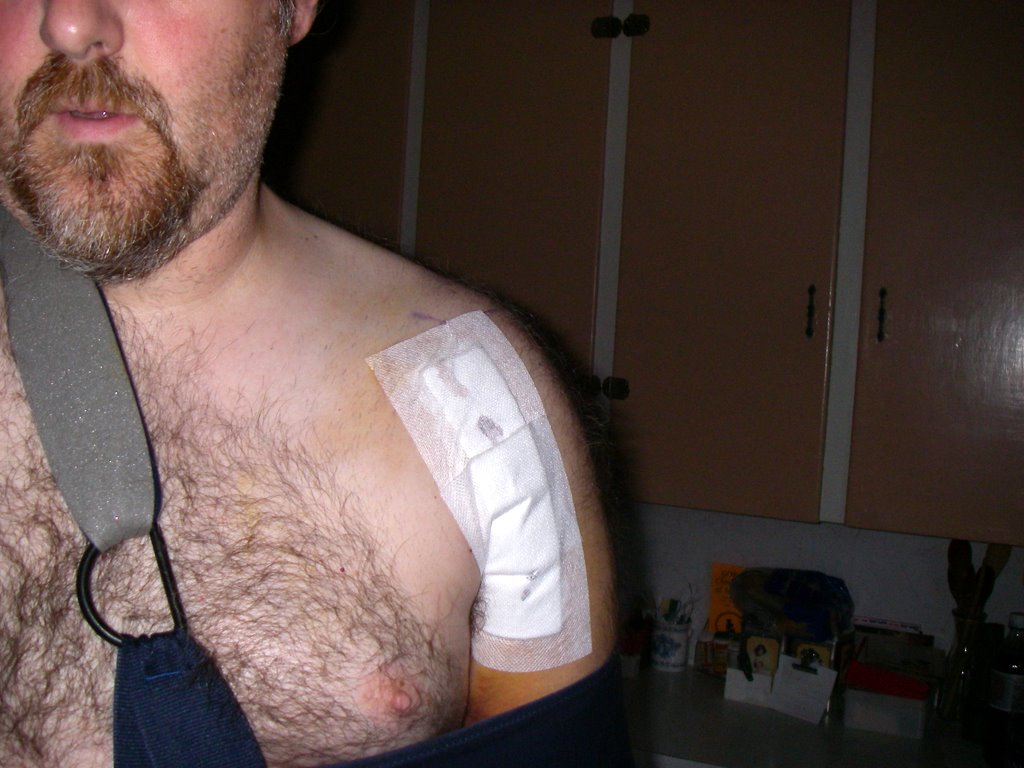
Finally, home. What does a man look like arriving home after major surgery for a crunched shoulder? Like this:


The first thing to do is to make me comfortable. The obvious place is the couch with lots of blankets.
My left arm is useless, so I have to sit on the right end of the couch so that I can use my right arm on the arm rest to help push myself up when I stand. I also need some pillows to support my battered left arm.
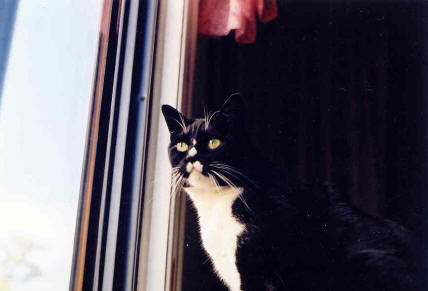
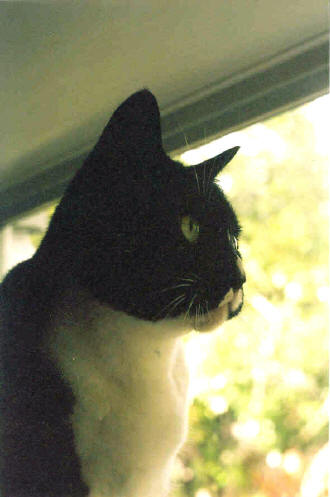
The downside is that now I can't curl up with my cat Linus, who has missed me and clearly realized something was up. In fact, we pile up extra pillows on the left side to keep Linus at bay; he's a large cat and likes to walk on me, and god forbid he should walk on my injured shoulder. Still, being home with my cat is a great start to my recovery, and he even seems to understand that although I am injured and can't really snuggle him, I did miss him and am glad for his company.


This is pretty much how I stayed for a couple of days. Sleep was impossible. Between the dull ache in my arm and my back stiffening up, there was no sleep to be had. In fact, I considered it an improvement when I was able to move to various chairs around the house during the night and not sleep in any of them. At least I was moving. But before I worried about my first night's sleep, there was another problem that I needed to face.
I needed to pee.
My bathroom is small. Tiny. The toilet is in a small alcove with little if any maneuvering room. And the transition from standing to sitting is painful and uncomfortable. And I am still wobbly. Pulling up my pants is awkward. So I have little choice. For the time being, I'm going to pee in the sink.

A couple of sleepless nights later, I was starting to smell. I needed a shower.
The only restriction I had about showering was to try and avoid having the shower spray directly on the incision. A little collateral water damage okay. I would also have to change my dressing afterwards. My dressing looked like this:


In order to have my shower, I would have to get undressed and get my arm out of the sling. Then I would gently get in the shower and somehow do all the necessary hair and body washing one-handed, then dry off, then get dressed again. My sister volunteered to stand by if needed. I told her that if she heard a splash and a thud followed by screaming, chances are that I would be in need of some assistance.
In actuality, the shower went well. Slow and steady wins the race.
The only problem was that I couldn't get my underwear on. Because of the aforementioned limited space in the bathroom, I had not yet managed to sit down on the toilet, and sitting down was the only way I could get pants and/or underwear on. Getting tired and a little frustrated that I couldn't devise a plan for my underwear, I had no choice but to call my sister through the closed bathroom door.
"Sis, I have a problem."
"What is it?"
"I can't get my underwear on."
"How did you get them on in the hospital?"
"I was on morphine. I don't remember."
"Oh."
"So I thought you could hold them in front of me. I'll step into them and you can start them up my legs. I should be able to grab them when they reach my calves and I can pull them up myself."
My sister reluctantly agreed. I opened the door a crack, and passed her my underwear.
"Are you ready?" I asked. She nodded.
I opened the door, naked as a skinny-dipper at Mackenzie Bight. She knelt in front of me, holding out the underwear and averting her eyes. I stepped in and reached down to grab the waistband.
"You'll have to lift them higher. I can't reach down that far."
She leaned in a little closer, and lifted them a bit higher. Now I could grab them.
"How's that?"
"That's great, sis, thanks. I got 'em. Don't hit your head on anything on your way up."
"Okay, glad I could--- oh, oh, you...."
She turned red and ran.
I went back into the bathroom and chuckled.

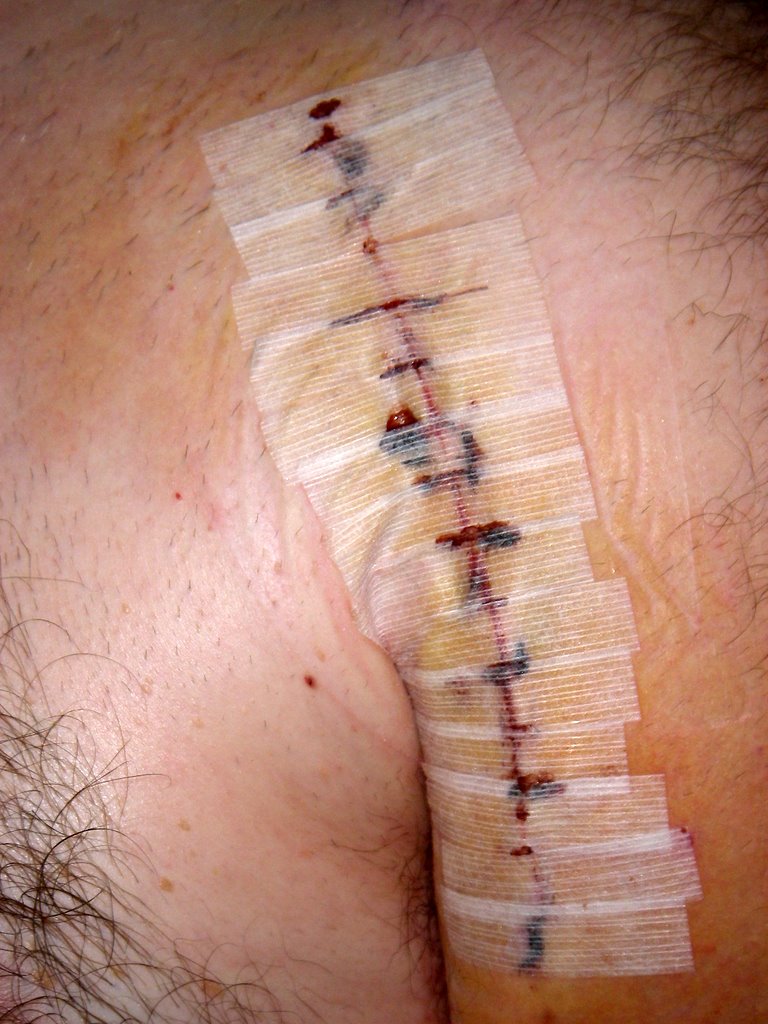
Then we changed the dressing. What did my incision look like? It looked like this:

I'm guessing 17 sutures. It's hard to tell, and they were dissolving sutures, so after a couple of weeks they were all gone anyway.

I had two big problems that first week. One, my arm was swelling up. I expected swelling around my shoulder and upper arm. That only made sense, that's where the injury and the surgery was, but the swelling was going down my arm towards my fingers, too. In fact, my fingers soon became giant white sausages. My whole arm was swollen and I was concerned, but the swelling soon passed and my arm returned to normal, Or what passes for normal these days.
The other problem was sleep. Or the lack thereof. After a couple of days, I moved off the couch and tried my bed. But nothing worked. I could not find a comfortable position or place to sleep. Worse, I was getting pretty wired from the Tylenol Extra Strength I was taking. I spent a couple of nights absolutely tripping out on the stuff. I took this picture at 3:00 one morning. Why? Because when you're basically immobile, dead dog tired, and hopped up on Tylenol, there really isn't much else to do at three AM except take your own picture.


My first physio appointment was a week after surgery. It snowed that day. Yes, my first trip out of the house with my busted shoulder and arm was on a day it snowed six inches.
At the rehab clinic, I meet Jim, my therapist. "Bike accident, eh?" he says. "Let's see what you did to yourself."
He consults my chart. "Uh huh, uh huh, hmmmm, uh huh, uh huh. Now that's interesting. Usually you don't see both of these injuries together. Usually, it's one or the other. But not both. Very unusual."
My elation upon hearing this knows no bounds.
There's not much treatment during this first session. Not much can really be done until the swelling in my arm starts subsiding. But he does ask if I have any problems.
"Can't sleep," I mumble between yawns.
"We can fix that."
He asks me to lie down on my back on the examining table, and he grabs some pillows. He sticks one under my head, a couple under my knees, and slides another one under my left arm, between it and my body.
Oh my. Suddenly, I'm totally relaxed.
That night I set up the pillows on my bed the way Jim did. I'm worried about Linus. Our ritual the past few years has been that he always jumps on the bed and curls in between my left arm and my body. If he tries that, it's going to hurt. I settle in with the light off and await Linus's arrival.
He hops up on the bed. Somehow he knows that the left side is off-limits. Without hesitating, he curls up in the crook of my right arm.
We both sleep for eight solid hours.

Thursday, January 11, 2007

Check the Sofa for Loose Change

Time to gather up all that loose change. According to this CNN story:
"In a U.S. government warning high on the creepiness scale, the Defense
Department cautioned its American contractors over what it described as a new
espionage threat: Canadian coins with tiny radio frequency transmitters hidden
inside.
The government said the mysterious coins were found planted on U.S.
contractors with classified security clearances on at least three separate
occasions between October 2005 and January 2006 as the contractors traveled
through Canada.
The U.S. report doesn't suggest who might be tracking American defense
contractors or why. It also doesn't describe how the Pentagon discovered the
ruse, how the transmitters might function or even which Canadian currency
contained them.
Further details were secret, according to the U.S. Defense
Security Service, which issued the warning to the Pentagon's classified
contractors. The government insists the incidents happened, and the risk was
genuine."

The story goes on to name China, Russia and France as the chief suspects. All three countries apparently run spy rings in Canada virtually unnoticed.
The Canadian spy agency, CSIS, says it has no knowledge of the coins.
So I guess all those crazy paranoids who've been telling us for years that the government keeps track of us with transmitters in our money weren't so - ahem - looney after all.

Wednesday, January 10, 2007

Rush to Execution

While the US is busy denying it, Gwynne Dyer thinks that the US wanted Saddam executed ASAP.

"It's as if they had taken Adolf Hitler alive in 1945, but ignored his responsibility for starting the Second World War and his murder of six million Jews and just put him on trial for executing people suspected of involvement in the July 1944 bomb plot. With all of Saddam's other crimes to choose from, why on earth would you hang him for executing the people suspected of involvement in the Dujail plot?
Because the United States was not involved in that one. It was involved in the massacre of the Iraqi Communists (the US Central Intelligence Agency gave Saddam their membership lists). It was implicated up to its ears in Saddam's war against Iran -- to the point of arranging for Iraq to be supplied with the chemicals to make poison gas, providing Baghdad with satellite and AWACS intelligence data on Iranian targets, and seconding US Air Force photo interpreters to Baghdad to draw Saddam the
detailed maps of Iranian trenches that let him drench them in poison gas.
The Reagan administration stopped Congress from condemning Saddam's use of poison gas, and the US State Department tried to protect Saddam when he gassed his own Kurdish citizens in Halabja in 1988, spreading stories (which it knew to be false) that Iranian planes had dropped the gas. It was the US that finally saved Saddam's regime by providing naval escorts for tankers carrying oil from Arab Gulf states while Iraqi planes were left free to attack tankers coming from Iranian ports. Even when one of Saddam's planes mistakenly attacked an American destroyer in 1987, killing 37 crew-members, Washington forgave him.
And it was George W. Bush's father who urged Iraq's Shias and Kurds to rebel after Saddam was driven out of Kuwait in 1991, and then failed to use US air power to protect the Shias from massacre when they answered his call. The US was deeply involved in all of Saddam's major crimes, one way or another, so no trial that delved into the details of those crimes could be allowed.
Instead, the spin-doctors in the current Bush administration put the Dujail trial first and scheduled the trials for Saddam's bigger crimes for later, knowing that they would all be cancelled once the death penalty for the Dujail incident was confirmed. The dirty laundry will never have to be displayed in public. But it does mean that the man who was hanged last Saturday morning not only had a farce of a trial before a kangaroo court; he was executed for the wrong crime."

Tuesday, January 09, 2007

Starfish Gallery Farewell

It is with great sadness that I received the final e-newsletter from Starfish Gallery. They closed the doors at the end of December and the three main glass designers go onto other art projects. There will be a final sale (from the newsletter)

There will be three aspects to the contents of the sale. Firsts: some of our regular stock that we want to clear out at unprecedented discounts! Seconds: the usual accumulation of almost-good-enough pieces plus garden art, weird bits and blobs and the terrifying contents of “Gary’s room”. Junk: everything else that we want to clear out, miscellaneous non glass stuff such as display items, office equipment, wood, tools… ten years and 8600 square feet of accumulated stuff - come and get it!


Friday January 19, 5:00 pm – 8:00 pm and…
Saturday January 20, 10:00 am – 4:00 pm

At 630 Yates – the last time the building will be open to the public as Starfish!
terms will be cash and carry as usual. Call fax or e-mail for more info.

I'm going to try and get there Saturday but I'm sure the pickings will be slim. However, knowing Bernie and Paula I'm sure they will make a trek down, especially at the mention of tools. If either of them goes I hope they have the good sense to grab pieces of glass to give to their friends (ie: ME!!) for presents.

Ever since the first time I walked through Starfish Gallery's doors 9 odd years ago, I have had a respect for glass. I've taken out of town visitors to see shows and have stood in utter awe struck silence as pieces were formed in front of my very eyes. I've given three of my best Christmas presents from Starfish Gallery--the beautiful Christmas balls--one hangs in my parents condo, one hangs in my former friend/hairdresser's house and one is with a friend in Germany.

Victoria has lost a wonderful gallery and a venue that will be sorely missed.

Monday, January 01, 2007

The Big Ouch: What Happened Part Three

"Go towards the light," said the voice.
I could see the light, beckoning, calling.
I have not had any surgery or anesthesia since having my tonsils removed as a child. I have no recollection of being under.
"Go towards the light."
Sometimes things go wrong in surgery. You don't wake up. Could this be happening now? Could the surgery have gone horribly wrong and now I was to find out the answers to the ultimate question of life, the universe and everything?
"Go towards the light."
Or was something else happening?


1:15 am.
The nurse comes by and offers me a drink of water. It will be my last drink before surgery. She asks when the last time was that I went to the washroom. It's been hours, so she suggests that I go.
She helps me out of bed, and I stagger along the floor, my busted left arm and shoulder in a sling, my right arm dragging my IV rack. I make it out of my little area, but I have no idea where the washroom is.
"Which way?" I ask.
She points to my left. A door is open, with a light shining behind it.
"Go towards the light."
"A fine thing to say to a person hours before surgery," I harrumph.
"Oh great," she mumbles, "it's going to be one of those nights."

It's amazing how much your life can change in an instant. This morning, I was dreaming of an 18' kayak. Now, after tumbling off my bike, I'm wondering if I can go to the bathroom without screaming.
Kayaking is a distant memory.

There was no screaming. In fact, the entire process was mostly painless. I return to bed, and sleep in fits and starts. I awake around 7, about 45 minutes before surgery. Breakfast arrives for the other patients, but not for me. The nurse warns me that should a breakfast accidentally arrive for me, I shouldn't eat it. I haven't eaten in 18 hours now, but I'm not hungry. In fact, I will go about 30 hours between meals. I was never hungry.

The nurse returns to explain the procedure. Around 7:45, the anesthesiologist will come and sedate me. (This never happens.) They will wheel me into the waiting area, then the operating room. The anesthesiologist will then inject something into my IV and put me out, and from my point of view, I will wake up right away in the recovery room. No time will pass for me. I may be a little disoriented, but it should pass quickly. No dreams.
The anesthesiologist does arrive, with questions for me, plus papers for me to sign. Then an orderly comes and wheels me into PreOp.
I don't give it a lot of thought, but it does occur to me that I may be facing my last conscious moments. Mistakes do happen. Things sometimes go wrong. But I'm resigned to my fate. It's in the lap of the gods.
I'm wheeled into the orthopedic surgical room. The operating table is narrower than I thought it would be and there's some discussion of how to transfer me from my bed to the table. Finally, I say that I will walk over to the table. Someone helps me up and off the bed, and I cross over to the table and lie down.
It hurts, of course. Lying down on my back is the most painful position. Someone calls for "shoulder extensions"; the bed is so narrow that my shoulders hang off the sides, and for my mangled left shoulder, this isn't helping.
I'm not aware that the shoulder extensions ever arrive, and now the anesthesiologist has my attention. He explains that during surgery, they will be freezing the areas they operate on. This will reduce the pain when I come around. I'm all for that.
He starts by poking something between my left shoulder blade and neck. He's trying to find a certain nerve or muscle group, I guess. He wants me to tell him when I feel a tingling like a mild electric shock.
"Feel anything?"
"No."
"Feel anything?"
"No."
"Feel anything?"
"No."
"Feel anything?"
"No. Wait. There's a bit of tingle. By the shoulder blade."
"Okay, good. That tells that I'm in the right area--"

Then I open my eyes.
Which is odd because I do not remember closing them.
But my first sensation is a good one. My left arm, even though it feels sore and swollen, also feels attached and whole again.
I focus on a clock on the wall. It's almost noon. Four hours have passed in a blink.
There's a machine beside me automatically checking my vitals. I can feel it inflating to check my blood pressure.
I glance over at my left arm. I have a long bandage stretching from above my shoulder to half-way down my arm.
A nurse appears. She says everything went well, but the surgery was four hours, not the planned two and a half. They found additional damage in my shoulder to repair. They kept re-locating my shoulder and it kept falling out. So in addition to screws and a plate in my arm, they also performed a Bankart Repair. This is a procedure that ties a strip of muscle across the joint to hold the arm in place in the shoulder socket. I don't know it at the time, but this will slow down my recovery, and probaly permanently decrease my range of motion.
The nurse leaves as she tries to find a bed for me; they did the surgery even though they did not have a room to put me in afterwards.

What else did they do to me? They put in a plate and screws to fix my arm. They repaired a small break in the shoulder socket; unfortunately it was where some tendons and ligaments were attached so they had to be repaired. Also, a lot of muscle had to be re-attached as it had come away from the bone. Here's what my shoulder looks like now:


Yes, the plate and pins are permanent. I will never have an MRI and I will beep at airports.

The nurse returns, they found a bed for me. I ask for a drink of water. My throat is killing me -- it's raw from the breathing tube they had down it.
I'm wheeled to my room, pumped full of antibiotics and morphine. I'm tired and I feel like sleeping, yet I also don't want to sleep. Mostly, I just sit dazed, occasionally nodding off.
Karl will visit me around 5:00 PM -- I spent more of his visit asleep than awake. Others will visit me. Louise, Brenda, my niece Kai all stop by. Paula and Bernie visit. For some perverse reason, Bernie is mostly concerned that my right hand still works. Paula thinks I look like I've been hit in the face with a sledge hammer. Not that there's anything wrong with my face, but because the shock of this life-altering moment is still sinking in.
Dinner arrives around the same time Karl does. It's a fish patty thing, which wasn't very good. The mashed potatoes are excellent. The nurse tells me to go easy -- it's my first meal in 30 hours. I nibble at it.
Details are a blur, but I am constantly poked, prodded and checked by nurses. Everything seems to be normal.

I'm sharing my room with three other patients. Across from me is a young guy who's here for the long haul. He's just ordered a tv. He knows all the nurses by their first names. They are asking him for advice on his course of treatment. I'm guessing dialysis.
Beside me is an old lady. I'm never sure what is wrong with her, but she seems to have all sorts of ailments. She is constantly being taken out for tests.
The third roommate is an older man who's left left hand got into a fight with a table saw. I give the victory to the man only because all his fingers are still attached.

Afternoon fades into evening, and into night. It's early in the morning now. And I need to pee. There's no nurse around, so I slowly sit up. My back is killing me. I carefully stand and walk to the washroom, dragging my IV rack. A nurse has already helped me do this a couple of times, so I already got the hang of it. When I return, I stop at the window and look out. I can't see much -- most of the view is blocked by the roof of another part of the hospital. But I can see the tops of some trees, some streetlights, and clouds.
I miss being outside.
And it will be along time before life becomes normal again.
I carefully climb back into bed.
Sleep eludes me.

In the morning, I go down for x-rays. It is there that I see for the first time the steel and pins that are now part of my arm.
Holy jeez. I'm bionic or something.
The rest of thr day is a blur. More drugs, more pills. More blood tests. They want me out -- they need the bed. In mid-afternoon, I get the word. I can go home.
My long recovery begins.

Sunday, December 31, 2006

The Tragedy of December 1991

Stephen Cohen puts forward a compelling case that the breakup of the Soviet Union under Yeltsin was in fact the death knell for democracy in the USSR. There's been a lot of stupid stuff written by some very smart people to explain how radically free markets would take Russia forward into utopia, and when it didn't work it was obviously a flaw in the Russian soul rather than a stupid theory. As you read them, it becomes clear that this is theological bullshit dogma rather than argument based on evidence. Truth is, by adopting the neo-liberal crap, Russians may be worse off now than at any other point during their history. Many thousands are now living through conditions worse than those at the time of the seige of Stalingrad.

Friday, December 29, 2006

Theme Party--Hawaii

Theme parties are always fun! I've done one or two in my time and attended a few in my youth. Seems the theme party idea went out of style.......of course everything old becomes new again and today the theme party was the topic in my e-newsletter Sweetspot.

I highly recommend visiting the Hawaiian music site. I never knew Hawaiian music could be so much fun!! There is even a Christmas album which may become the "must have" album for my collection of odd Christmas tunes!


Décor
First, we're picking a theme for our impromptu party and going retro-Hawaiian with inspiration we picked up from our last trip to London's coolest pub, Trailer Happiness. (But any theme will do.) We're decorating the room with party lights (stolen from our Christmas tree), surf boards (erm, or in our case our snowboard) and colourful tropical fabrics (please, who doesn't have access to a thrift store boasting racks of $1.99 Hawaiian shirts?).

Guests
We're playing telephone, spreading the word with our guests coming in beachwear. If we're really ambitious we'll make leis out of paper and string. One of our favourite online resources is Party 411. They've got all the supplies we need for our pseudo-Luau.

Sips and Eats
We're serving Mai Tai cocktails, fresh fruit, shrimp rings and some yummy Ono Ribs. But there are more tropical-themed recipes in this awesome online guide.

Tunes
Set the mood with some Hawaiian music. We're downloading tracks from www.hawaiianmusicstore.com.

Entertainment
Nothing says Hawaiian than Elvis in Blue Hawaii. We're renting the DVD and popping it on for some side-splitting backdrop entertainment. Long live the king! Then later (after the Mai Tais kick in), we'll be suggesting a couple of rounds of Identity Crisis or The Therapy Game. We may even try our hands at island-authentic limbo and hold our own how-low-can-you-go contest. Party 411 has the kit.

We're feeling the Waikiki heat...all we need now are a few sun lamps, sand and a cabana boy to say "Aloha!"

Wednesday, December 20, 2006

Linus: March 28, 1990 - Dec 19, 2006


Linus, the most beloved and bestest cat in the history of the world, passed away peacefully in his person's arms yesterday after bravely facing a short and sudden illness. He was nearly 17.

As a kitten, he quickly mastered all the difficult tricks: flying, levitation, wall climbing, and plant destruction. It was during this phase of his life that he earned the nickname "Booger-cat!" which stuck with him his whole life. But he was a gentle and loving spirit that won over all he met, cat-lovers and cat-haters alike.


As he matured, the "boogerish" aspects of his personality faded, and he remained gentle and sweet, and a constant "couch buddy" to his person.


There will other cats in his person's life; there will never be another cat like Linus.
Linus leaves behind an empty sunbeam, his toy mouse, his spot on the couch, his sixteen-year old scratching post, the cat blanket he never used, and the tears of his heart-broken person.


Linus, my friend, companion, and furry hot water bottle, I miss you terribly...

Saturday, December 16, 2006

Who Needs A New World?

When we haven't finished finding out about this one yet....

I'm sure by now that everyone has seen the photos of the new cuddly christmas toy, the yeti crab

Image: (c) 2005 Ifremer / A. Fifis


There is a great page about where and when it was found here.

But there was more to this years marine census; In the Nazare Canyon of the coast of Portugal, at about 4,300 metres down, researchers found a single-celled organism that is a full centimetre across.Apparently, it is encased in a "plate-like shell...composed of mineral grains.

Another interesting article here.

There is a Canadian connection to the Census of Marine Life; researcher Ron O'Dor is the Senior Scientist with COML.

Man, we really know nothing about this planet and its complex ecology.


powered by performancing firefox

The Big Ouch: What Happened Part Two

The one nice thing about being seriously injured is that you go to the front of the queue at Emergency. This was probably a good thing, as by the time the ambulance got me to VGH, my arm was really hurting and I could feel myself getting more uncomfortable. I was probably going into shock, perhaps not deeply, but going there.
As I was waiting to be admitted, one paramedic noted my discomfort and offered me a blanket. Being a stoic male, I declined the offer.
"Let me give you some advice," said the paramedic. "When a paramedic offers you a warm blanket, you should take it."
"Golly," I said, "maybe I'll take that blanket after all!"
It was now about 6:00, about an hour after I fell off my bike.
Soon, I was wheeled into a cubicle, where they quickly started me on an IV. A doctor came in, took a quick look and very quickly determined that at the very least my shoulder was dislocated. He asked if I had any numb patches and I indicated I did, on the side of arm. This could mean nerve damage.
Then he uttered the one word that I was longing to hear: morphine!
But soon I was left alone, and I reflected on my situation. I would need help tending to my sick cat. Someone was going to have to call work and let them know I was going to be off for a few days.
I looked at my arm. Man, I really wrecked it.
By this time, more of my guardians began arriving. First, my sister Brenda arrived, followed by my girlfriend Louise. Each time, the nurse mistook them for my wife.
My memory of events during this period is somewhat fluid, but somewhere between the blood tests and the IV drips, they took me to X-ray.
This was not an experience I'd like to repeat.
The x-rays taken while I was standing up weren't so bad, but I had to lie flat on my back for a set and this really hurt. I never saw any of the "before" X-rays until much later, but lying flat was excrutiating and I could clearly feel bones floating around in there. That was 20 minutes that I never want to repeat.
But interestingly, the numb patch in my arm regained feeling after the x-ray ordeal. I surmise that something moved just enough to take pressure off the nerve, and there were (and are) no more concerns about nerve damage.
I was taken back to my room to await judgement. Brenda and Louise both commented about how cold my hands were.
Soon, a young woman appeared, the orthopedic intern. She'd looked at x-ray, and reported that my arm was broken in three places and my shoulder dislocted. Worse, I had broken ay arm at the ball joint, making repairs all the more troublesome.
Here's the x-ray:


Now, I'm no doctor, but clearly you can see that the shoulder is out of the socket, and the ball is broken, and not in the correct shape.
She said there were two courses of action. I was going to need surgery on the arm, no question. But do we fix the dislocation with surgery at the same time, or do we fix the disocation manually, then do surgery on the arm later?
This didn't seem like much of a choice to me. If I'm going to go under the knife anyway, must as well do it all in one go.
But she wanted to call in some experts, so who am I to argue?
Somewhere along the way, the paramedic's gear was removed from my arm and replaced with a sling which I am still wearing. (I'm typing this one-handed, so plus read this at half your usual reading speed to get the full effect.)
The intern returned with the verdict.
"When I suggested we fix the dislocation first, everyone laughed at me."
There were two problems with her plan. First, the ball was broken off. It was not attched to the rest of the arm. There was no way to re-insert the ball into the socket. It probably would have caused more damage. Secondly, even if it was safe to proceed, she probably couldn't have done it.
I'm a big guy, and she was not a big girl. (She made Chantelle at work look like Shaq.) She physically could not have done it and the last thing my broken arm needed was someone heaving and hauling on my shoulder.
She said she would start on the paperwork and took a felt pen and initialed my injured left shoulder.
So it was surgery, a one-stop fix everything chop. Sort of like Midas Mufflers.
Surgery was set fot 7:45 the next morning, not at VGH, but at Royal Jubilee Hospital. The only question was, could they find a bed for me there? An ambulance was ordered anyway to transfer me. Louise and Brenda said their goodbyes and headed out to spread the word that I would, in fact, live. They noted before they left that my hands were warming up.
A nurse returned with the paperwork for me to sign, but stopped herself before handing it over. It seems that the intern, despite having examined and marked my injured left shoulder, put down on the forms that it was my right shoulder that was to be operated on.
Oops.
Once the paperwork was fixed, I signed. Good thing I'm right-handed.
So there it was. I was facing my first surgery since having my tonsils out when I was 5.
The orthopedic surgeon, my newest guardian, drove over from the Jubilee to examine me. He explained that the surgery would take about two and a half hours. I've heard since that he is the best "shoulder man" on the Island. So far, I'd have to agree.
Around about 11:30, an ambulance arrived to transport me to the Jubilee, they found a bed for me, so we were all set. They loaded me up, and away we went. It was a quiet night for emergencies, the paramedics said. The quietest night they'd ever seen. They'd been on duty for six hours, and I was their first call. And I was just a glorified taxi ride.
By 12:30, I was safely tucked in my bed in Jubilee. Surgery was mere hours away.

Wednesday, December 13, 2006

The New Normal?

So there's been two more storms this week, both with high winds blowing in from the east--which has meant some amazing waves in Cadboro Bay. It also means that two more boats have torn loose of their moorings and washed up on the beach. One, a 4 metre powerboat is almost directly in front of Sinclair Road. It is thrashed--big chunks broken out of the side and back. The other is a five or six metre sailboat that has washed up a ways down the beach--where the other group of three ended up. I haven't been down to look at it, but it seems to be in okay shape, and just waiting to be hauled off and re-moored.

But somehow I suspect that this new ferocity and frequency of storms is just the new normal for the Island. The general feeling is that our winters are to become wetter and stormier while the summers become hotter and drier. Last summer we went four months without measureable rain which certainly put a significant dent in our water supply (and Tofino, for various reasons, ran out of water). But according to our Prime Minister and our Environment Minister (Rona Ambrose), there is no reason that Canada should cut back on greenhouse gas emissions.


powered by performancing firefox

IBM and What?!

This is one of those "things you might not have known" stories. You know, like the history of Prescott Bush. IBM helped the National Socialists with their "Final Solution" difficulties during the Second World War. GNN has put together a short video on the topic you might find interesting.


powered by performancing firefox

Saturday, December 09, 2006

The Big Ouch: What Happened Part One

It's an odd sensation, realizing that your bicycle has suddenly stopped but you haven't. That your handlebar has suddenly snapped to the right and stopped your bike cold while momentum is still carrying you forward. That not only are you flying over your handlebar but that you are twisting in mid-air to the right and are now travelling sideways, a change of direction that will probably save your life, but in this moment only adds to the disorientation.
Then you realize that the ground is getting closer. You barely have time to register that this is going to be bad. And that it's going to hurt.
It is bad. And it hurts.

Two and a half weeks ago I was riding my bike home following the path I do everyday. Part of the journey is a short trail connecting Burnside Road with the back of Tillicum Mall. On this day, dusk, 5:00 pm, water had washed out a pothole that had been filled by gravel back in the summer. Was the washout caused by all the rain we had received in November? Or was it run-off from the watermain that had burst in Tillicum Mall an hour previously? I don't know. All I do know is that as I went down the path, my front wheel caught the pothole and I flipped off my bike. There was a small culvert ahead of me with a concrete pad over top of it. I landed on the concrete pad with all my weight on my left shoulder.

"Ummmfph!"
The air rushed out of my lungs on impact. I bounced off my shoulder and onto my back (my backpack, actually). My legs swung up beside me and ended up in some bushes just off the trail. I'm not sure what happened to my bike. At least it didn't run over me.

I knew right away something was wrong with my left arm. It didn't feel "attached" properly. Still, I tried to gently move it, but the pain toldme that I had probably broken it. There was also the disquieting sensation of things rubbing together that should not be rubbing together.

Okay, so the left arm was clearly an issue. What else was broken? I hadn't hit my head (and yes, I always wear my helmet). I wiggled my toes, they seemed okay. My right arm seemed fine. It felt like I might have a scrarch on my left leg, but this was minor. Everything seemed up and running save my left arm.

I needed my cell phone which was in my backpack, and was now underneath me. Okay. This was gonna hurt, but there wasn't much else to do. Cradlling my left arm as best I could, I swivelled on my butt, getting my legs out of the bushes. Then I sat up.
Yes, it hurt.
I rested a moment, then cradled my left hand in my lap, then slowly unbuckled and removed my backpack.
I somehow managed to get my left arm out of the straps, then I opened it up and fished out my phone. I turned it on, hoping that it still had some juice. It did, I dialed 911. The operator was cool and professional and able to figure out what trail I was on. He asked if I was bleeding; I said I didn't so. He asked if I could get up and walk along the trail. I said I probably could, but I'd just as soon sit where I was.
I hung up and started to call family members to alert them to my plight. I told my mother that Louise would call soon. (I was supposed to help Louise move some furniture that evening -- clearly, I would do anything to get out of that.)
Just as I finished calling my mother, my first guardian of the evening arrived. A gentleman named Ollie rode down the trail and stopped to assist me. He picked up my bike from across the path and offered to wait the ambulance came.
When the ambulance arrived, Ollie, who as it turned out lives just a couple of blocks from me, offered to take my back home.
The bike was fine. Of course.
The paramedics checked me out. They cut away my bike jacket and jersey from my arm. I'm no doctor, but I could see that my shoulder looked wrong. Instead of curving down, it suddenly dropped off, and there was a large bump where there shouldn't be a bump. This was the ball joint at the end of arm sitting in a place where it shouldn't be. They checked my arm for numbness and I had a big numb spot on the outside of left arm. This indicated possible nerve damage.
They immobolized my arm by wrapping what looked like a life preserver around me, they got me to feet and we walked down the path. I climbed into the ambulance and sat down. They moved me over to the stretcher later as they tried to put in an IV line in my right hand. The paramedic kept failing to find a vein and apologised profously for continually poking my right hand in vein, er, vain. We went to Victoria General Hospital.

Friday, December 08, 2006

We're not going to have a war, we're going to have the appearance of a war

Oh yeah, why is it that there isn't enough bullshit in the world to worry about and get active over, but that the idiots on the religious right have to make shit up? Really. And you'd think that they'd know better--particularly with that whole injunction against bearing false witness and such. Personally, I'd love to wage a war against Xmas, but you know, in the long run I think I'd rather wage a war on poverty, or HIV, or child labour, or any of a thousand other things that make my blood boil a hell of a lot hotter and faster than Xmas. Although, if I could do a surgical strike on Xmas muzak.....


powered by performancing firefox

Cain't do it. Just cain't...

That is, of course, George Bush. He just cain't talk to Syria and Iran. Cain't do it. Won't do it. Meanwhile, Saudi Arabia, long time Bush buddies, stand accused of funneling millions into Iraq to buy arms for the resistance. But them, he'll talk to. In the meantime, you only need $2,200 in assets to find yourself in the wealthiest 50% in the world. With a million in assets, you've made it into the top 1%, and you and your buddies control, well, everything. The top 2% command over half the world's wealth, according to a UN report covered by the Reuters news agency. If the world's population, according to the director of the World Institute for Development Economics, were reduced to 10 people and the world's wealth to $100, then one person would have $99 and the other nine would be left fighting over a dollar. And since reagan/Thatcher, this has just gotten worse instead of better, and worse at an increasing rate. It's a miracle we can walk this planet without being killed and eaten by the seriously poor. No wonder we're envied and hated.


powered by performancing firefox

Thursday, December 07, 2006

Is Victoria Sinking?

The Sierra Club thinks so. Here's how they envision climate change affecting the coast around Victoria.

Quiverfull

Quiverfull; a "Christian" movement that's trying to populate the world...with home-schooled fundamentalist "Christian" babies. Building an army with the fruit of their loins (eesh! what an image, fruit of loins...).

What is it about women that drives men batshit? Okay, not all men. Primarily men who follow one of the Abrahamic religions. Are men really so pathetic, or are we just culturally modified to be crazed control freaks with a deathly fear of vagina dentata?

I think about my grandmother bearing 17 kids and how, in her 70s, she still bore a grudge against the town doctor for not helping her out with any form of birth control. She sure as hell noticed that his wife stopped after bearing only two.

For some reason, our culture is having trouble looking outside itself; unable to see that what we want might just be what other people want as well. Things like freedom from unreasonable search and seizure, the right to confront our accusers, control over our fertility, the ability to be self-determined actors in our own lives. We want it, but we're not really willing to allow others the same right to make their own choices. If a culture is defined by how it treats its women--and a damned good case can be made that it is--then the Abrahamic religions have a lot to answer for around the world.


powered by performancing firefox

Sunday, December 03, 2006

Why does this feel weird?

I was sitting in Starbucks--yeah, I know, but they really are my local coffee shop--and there was some not too bad music playing. Then there was a station ID; I was listening to Starbucks own radio network, which, the voice pointed out, was available exclusively on XM satellite radio. Okay, so you buy a satellite radio, pay a monthly or annual subscription fee, and then listen to ... Starbucks? This just feels weird, like some bizarre form of corporate incest run amok.

Must Be Tough

Well, seriously. It must be tough to realize that what you thought actually was a coalition of Christian groups turns out to be a front for a hate group. Two million deluded people who actually think that Christ would have put up with this shit for a New York second. And when someone actually wants to put serious topics on the table, he's told "These issues are fine, but they're not our issues, that's not our base".

When does a church cross the line from religious group to political action group? Seriously. Because one is almost above the law and the other has to abide by it. And in Amerika today, it seems that all you have to do is say that you're a church and bingo! you are. Even if what you're doing is acting as a fundraiser for the RNC or as a front for hate speech.

This is a serious question, because so many of these groups are acting in Canada. Just this summer my niece, nephew and I were approached by an Amerikan evangelical in a water park in Mississauga. To say nothing of the support for Ted Morton in the Alberta race for leader of the Conservative party. There is a lot of Amerikan time and money going into social control in Canada--just like in El Salvador, Argentina, Brazil, Peru and Iraq. And for the same reason--Amerika can't afford to have any part of it's neo-colonial empire slip away. And that means us.


powered by performancing firefox

Friday, December 01, 2006

A Month of Storms

Ah, Cadboro Bay. The Bay is a gorgeous place,  very protected, and looking out on a view that takes a backseat to no other.


I took this shot of the Bay back in late September, trying to catch the morning light coming over Ten Mile Point. The Chain Islets are visible in the middle distance, as are the Olympic Mountains over in Washington State (I find it amusing that while the border is officially the 49th parallel, only four of eleven provincial capitals lie north of the 49th. Here on the Island, you don't hit the border until Ladysmith).
Cadboro Bay is nestled on the east side of the lower tip of Vancouver Island, making it one of the safest and most sheltered bays around. Victoria itself is in a rain shadow from the Olympic Mountains, and then Cadboro is further sheltered by hills to the south and Ten Mile Point to the north.
But as the last month has proven (over and over again), even Cadboro Bay isn't always as placid as it appears in the photo. We've been hit by a month-long series of storms that have lead to record or near record amounts of precipitation, power outages, and more than a million people under a week-long boil-water advisory.
Locally, the phenomenon is refered to as the "Pineapple Express", which happens when warm, moisture-heavy air from the south Pacific meets an Arctic cold front running down the coast before heading over the mountains into Alberta. The result is amazing amounts of precipitation usually over a very short period of time. This time it was a sequence of storms slamming into the coast, bringing rain, winds over 100 kph, and this last week, snow. And then snow again.
While we went without power for several hours, people living near us went without for over two days. With temperatures below zero and windchills adding another -10C, this situation was nothing to be laughed at.
The first storm of the month saw this:


From all appearances, this boat had been in use right up until the storm. But it hadn't been moored in Caddy Bay--this is just where it washed up. Locals were very polite; they waited two full weeks before stripping everything of value out of the hull. By that point, what had been a damaged but repairable hull, had become a serious mess. The sequence of storms, high tides, and storm-driven tide  surge had shoved the hull up and into the stacks of driftwood on the beach. Then the new driftwood--logs ranging from 30 cm across and three metres long up to, well, the drowned tree resting next to the boat in the picture--had broken out the stern and punched new holes in the side of the hull. By the 20th of November, city workers had come by and hauled the hull off the beach.
But this wasn't all....


Three more boats had been torn loose from their moorings and tossed up on the beach. By the time I took this photo, the power boat and day-sailer had been filled with driftwood to keep them planted. But the big hull, the 10 metre one, well, that was another story.
The damage this boat had taken was extraordinary. It too seems to have been in use up until the storm that tore it apart. I walked down the beach to it the other day--less than three weeks after it washed up--and the hull is now in two pieces and shredded. The blue day-sailer was hauled back out to its mooring in the bay (of the three boats, this is the only one I've seen moored in the bay), but has since been pulled loose again and is nearly back on the beach for a second go-round. The power-boat has since disappeared--I suspect that Saanich hauled it away as well.
Even further down the beach was this:


This was one of the boats moored in the bay. It had simply torn loose and been beached. Fairly soon after taking this photo, this boat had been taken off the beach and re-moored--hopefully more securely.
So, in total there were five boats washed ashore during the first two storms of the month. Since then there has been a third storm and the snow. Quite the month. But, it appears, not unique. Under the tree near this last boat, is this hull. Obviously it's been there a while :-)


powered by href="http://performancing.com/firefox" >performancing firefox

Monday, November 27, 2006

The Big Ouch

Monday, I tumbled off my bike, seriously injuring my shoulder. We're taking pins, plates, possibly even a fork and spoon. I'll post more soon; suffice it for now to say that I am alive, and the long-term prognosis is good.
  Posted by Picasa

Tuesday, November 21, 2006

This just in -- newsflash!

Our most dedicated blog poster, John, took a tumble from his bike yesterday and ended up in hospital.
On the positive side, he recognised that he had an arm injury and actually made his own 911 call. A neighbour stayed with him till the ambulance came and took his bike home. This is actually quite surprising, as many men of my acquaintance (notably Bernie) would be more likely to push the bike home and call for a cab. Maybe the steep hill on which John lives was a factor in the decision, but I prefer to think that the wise choice John made was a sign that he may not have suffered any head injury in the fall.
On the negative side, he's in surgery right now and will not be biking or kayaking for a while.
We'll post what news we get (or John will himself) but for now we'll be optimistic about his surgery and send him plenty of good wishes for a full recovery.

Monday, November 20, 2006

Did you really think any different?

From The Guardian, this little bit of news about the woo-hoo new passports.


powered by performancing firefox

And how hungry are you?

This bit of footage from BBC News is of a pelican altering his habits just a bit.... This isn't the only time this has happened--as this footage shows.
The question that this raises for me is, does this have anything to do with the projected collapse of worldwide fish stocks? Or is this behaviour just something we haven't talked/written about? You know, like the tremendous amount of homosexual activity found across the animal kingdom that researchers just never mentioned. (Or check out Bruce Bagemihl's book Biological Exuberance, or Joan Roughgarden's Evolution's Rainbow for a different take on sexual behaviour and evolution).
I notice that the pelican behaviour above is taking place in parks--neutral spaces where human/bird interations are increased and wild behaviours are set aside--so the question comes up: is this a "normal" or common behaviour, or is the pelican just taking advantage of an unusual situation? That a pelican is eating a pigeon, well, considering the size and volume of their normal diet, it's not too much of a stretch to eat something pigeon-sized. But would the opportunity arise in a non-park setting?
BTW, when it comes to park settings and unexpected behaviour, this bit of video is good for a chuckle.

Sunday, November 19, 2006

Sociologists

Runte! --**tweet!**-- Hey, professor! C'mon over here.
You've been a scholar of sociology for years. Learning, teaching, discussing. YOU don't sound incoherent, even when you've been heard to say that you don't know about something and will have to think about it for a while.
I'm taking a course in sociology right now and discovering that sociologists haven't gotten any more coherent than they were back when I got my teaching certificate in 1984. (Orwellian jokes have already been made about that date and event.) They're damn near as incoherent as educational psychologists... oh wait, you teach that subject too. And you're not incoherent.
I am *so* going to have to quote some of your work in my assignments for this course.

Saturday, November 18, 2006

Bush in 'Nam

Ted Koppel has had the best line so far: "Thirty-five years ago he joined the Texas Air National Guard to stay out of Vietnam, and now he's going to Vietnam to stay out of Washington."
Not that Bush wasn't short things to say. Upon arriving in Hanoi, Bush remarked to reporters that the lesson of the Vietnam war is, "We'll succeed unless we quit."
Does Bush real know...anything? I wonder what his Vietnamese hosts thought of that statement.

Thursday, November 16, 2006

If It's Good Enough For The Juice....

With the world's most guilty innocent man OJ Simpson about to release a book call If I Did It, Here's How It Happened, describing how if he had stabbed and almost decapitated his ex-wife and her friend, here's how he would have done it, Marty Kaplan takes it a step further.
But OJ's ruse puts a whole new ploy in play. Imagine Rumsfeld writing "If I Committed War Crimes, Here's How It Happened." Plenty of juice, but no risk of international prosecutions. Rove could get a ton of dough for "If Bush Had Been Impeached, Here's What For."

Failed State

Yeah, you can't even think the word democracy when you talk about the United States anymore. Seriously.


powered by performancing firefox

It's not possible to be this clueless

The no-cons still running Washington (or, perhaps more or at least as accurately, the anti-democratic proto-fascists still running Washington) still think that there's something to win in Iraq. Now there's a report from the Guardian that the raving rightists want to commit more troops--some 200,000 more--to help stablize Baghdad.


"You've got to remember, whatever the Democrats say, it's Bush still
calling the shots. He believes it's a matter of political will. That's
what [Henry] Kissinger told him. And he's going to stick with it," a
former senior administration official said. "He [Bush] is in a state of
denial about Iraq. Nobody else is any more. But he is. But he knows
he's got less than a year, maybe six months, to make it work. If it
fails, I expect the withdrawal process to begin next fall." (The Guardian)


Ah yes, this has the stench of that old war criminal Henry Kissinger all over it. The old "realists" of Bush 1 are trying to construct a way to declare victory while giving up, but with Henry's help they'll find a way to stretch it out until thousands more have died. But what the hell, they're only rag heads, right? It's the couple of thousand Amerikan troops that matter, not the 500,000 to 1,000,000 Iraqis that have been killed by these butchers.

The Amerikan empire doesn't just need to be stopped. It needs to be shattered, the pieces pissed on, and the ground salted so that nothing will ever grow there again. I have to say that I'm opposed to the impeachment of Bush--that would let too many people (like Cheney, Rice, Rumsfeld, Powell, Feith, etc etc) walk away from their actions. Best case senario? An international war crimes tribunal like the one the Germans went through. Like the one Rumsfeld may be facing in Germany. A fair and honest hearing, and let those responsible become accountable. Radical fucking notion, that.


powered by performancing firefox

Wednesday, November 15, 2006

When You've Lost Pat Buchanan...

... you know you've lost the right.
Our hawkish elites bemoan the fact that Americans seem ready to give up on Iraq when U.S. casualties are not 10 percent of those we took in the Korean War. That is because they do not understand the nation.
Americans are not driven by some ideological vocation to reform mankind. We do not have the patience or perseverance of great imperial peoples. If an issue is not seen as vital to our own liberty and security, we will not fight long for some abstraction like democracy, self-determination or human rights.
It is a myth that we went to war to save the world from fascism. We went to war in 1941 because Japan bombed Pearl Harbor. That Hitler had overrun France, booted the British off the continent and invaded Stalin's empire was not a reason to send American boys across the ocean to die.
In 1990, Americans were not persuaded to throw Iraq out of Kuwait until Bush 1 got to talking about Saddam's nuclear weapons. Even after 9-11, Americans were skeptical of marching to Baghdad until we were told Saddam was building weapons of mass destruction and probably intended to use them on us. Americans have often had to be lied into war.
Democrats are probably reading the country right. Americans will not send added troops to Iraq, as McCain urges. They want out of this war and are willing to take the consequences.
But those consequences are going to be ugly and enduring. That is what happens to nations that commit historic blunders.

The occupation of Iraq has passed from brutality to mere idiocy

But, you know, don't take my word for it. Read the rest of the article at the Guardian.

Tuesday, November 14, 2006

And so it begins (maybe)....

The Center for Constitutional Rights filed a criminal complaint in
Germany today against outgoing Secretary of Defense Donald Rumsfeld.
The complaint requests that the German Federal Prosecutor open an
investigation - and ultimately, a criminal prosecution - looking into
the responsibility of high-ranking U.S. officials for authorizing war
crimes in the name of the so-called "War on Terror."
(Democracy Now)

War Crimes Suit Filed....


Yes, the world--and I do not mean just or only the governments (who would rather just shut up and go along to get along)--but the people of the world, the populations of Europe, Latin America, the Middle East, and even Asia from what I can tell, are plenty pissed with Amerik right about now. Hell, even Canadians feel that Amerika is a greater threat to world peace than any other country. And those who are paying attention know that it's even worse than that: Amerika is doing its level best to turn the clock back to pre-Magna Carta days.

And now Germany. Who else in the modern world has a greater understanding of what comprises a war crime? So who better to turn it about on the Empire?

And it doesn't get any easier for Rumsfeld, Cheney, et al. Former Brigadier General Janis Karpinski has already given evidence, and is willing to testify about where the orders came from. To quote the head; "Fmr. Abu Ghraib Head Janis Karpinski Points to Signed Rumsfeld Memo Listing Harsh Interrogation Techniques"

(a transcript of an interview with her is available at the link).

Any Amerikan standing in front of a war crimes tribunal means the end of Amerikan hegemony and possibly, just possibly, the birth of a new world. But I ain't holding my breath, eh?


powered by performancing firefox

Monday, November 13, 2006

It might be free if it wasn't paid for....

So much for the government's whingeing about "biased" media coverage of the Iraq war. New research suggests Tony Blair et al might have got off lightly: academics who have analysed coverage of the war have found that many media reports filed during the conflict favoured coalition forces - with more than 80% of all stories taking the government line on the moral case for war. "Our findings fail to offer strong evidence of media coverage that was autonomous in its approach to the official narratives and justifications for the war in Iraq," the report says.
So says this report in the Guardian newspaper:
The press toe the line

Sunday, November 12, 2006

Don't Point That Finger at Me

...because three fingers are pointing back at you.
Again, thanks to Alternet and Jennifer L. Pozner, a great article : The Terrrorists Who Aren't in the News

Pozner writes; Since 1977, casualties from this war include seven murders, 17 attempted murders, three kidnappings, 152 assaults, 305 completed or attempted bombings and arsons, 375 invasions, 482 stalking incidents, 380 death threats, 618 bomb threats, 100 acid attacks, and 1,254 acts of vandalism, according to the National Abortion Federation.

The religious right in Amerika has this habit of pointing to others who are committing the same crimes they are themselves responsible for. This pointing isn't restricted to those on the right--it is a common theme back at least to the begining of the 20th century in Amerikan politics; the biggest problem with the Nuremberg war trials was ensuring that crimes the Germans were charged with were not crimes that the Allies (particularly the Amerikans) had committed. In fact, proving that the Allies had committed the same type of act during the war ensured that the charges would be dropped at Nuremberg.
But there is a myth of purity in Amerika the Empire. I suppose that it is common to all empires, hell, all nations during all eras. Canadians and their national myth of not being a war-like people is a good example (Canadians are great at waging war--we're just really crappy at holding on to colonies other than our First Nations). This atitude that we can't possibly be doing anything wrong is, I think, what prevents us seeing how profoundly deep the democratic deficit is here in Canada. It's what also leads us to blame victims for our crimes (viz. First Nations, above).
But in Amerika this proccess has become institutionalized. The owned media cover only those stories which support the current national narrative--thus a great deal of coverage of the "good" being done in Iraq, and no mention of the terrorist wars going on at home. In Canada, it's how much good we're doing in Afghanistan as opposed to how little good we're doing at home.

But for some less sucky thoughts, check out this article on the power of the religous right in Amerika:
"God Gap" narrows in US politics


powered by performancing firefox

Saturday, November 11, 2006

WTF?

Once again, fear and desire drive men insane. No, really. Check this out (once again, thanks to Alternet):
http://www.alternet.org/blogs/peek/44112/
As a father, I find this deeply disturbing--and symptomatic of the horror at the heart of the Amerikan "Christian" Fundamentalist movement.

Comedic Eye for the Outraged Guy

So Rummy has left the building. Does anyone really believe this? This guy has been around since at least the Nixon White House, and survived like a cockroach after a nuclear blast.
Over at Alternet, Evan Derkacz has posted this bit from Craig Ferguson's talk show; http://www.alternet.org/blogs/peek/44142/
Craig refers to Rumsfeld as "a great friend of the show" in his intro to the footage of Rumsfeld's press confrences. The gag--the addition of hands making it look like DR is doing anything but answering the questions (or even listening to the questions)--is funny. But it speaks also to the attitude of the White House (and not just it's current occupants): when you're running an empire, why would you bother with anyone but your cabal? We have to keep things under control in order that we might continue strip mining the wealth of the planet. What the hell do you mean, we should concern ourselves with bullshit like democratic oversight?
Amerika may have been founded on the idea of keeping tyrants in check, but even the founding fathers decided that economics and social status trumped democracy. Even in the middle of a democratic revolution, they had to ensure that the hoi polloi didn't get their hands on any real power--those who know better must ensure that the masses don't do anything stupid, after all--and thoughtfully ensured that the structure of this new government was messy enough to impair it's effectiveness as a democracy.
Satire, like the clip above, is the last refuge of the outraged, mining the gulf of hipocrisy, exposing the differences between the private and public face. It is also powerless--even though occasionally someone becomes so big a joke they are forced from the public eye (Stockwell Day's leadership of the Conservatives comes to mind). But satire doesn't kill--not even careers (again Stock comes to mind). All satire really exposes is rage--and then bleeds that rage off before it becomes action. in politics, democracy is about agument and organization. Satire is about rage and powerlessness. So, less mock, more talk, walk the walk. That's democracy.


powered by performancing firefox

Friday, November 10, 2006

Liberals Lead Without A Leader

The leaderless Liberal party is outpolling the governing Conservatives and Prime Minister Stephen Harper in every province except Alberta.
What else can you expect from a province that keeps electing Ralph Klein?

Thursday, November 09, 2006

The Coming Train Wreck

With Rummy gone and Bush on the ropes, with Democrats running Congress again, everything should be fine now, right?
Robert Jenson doesn't think so.
Here’s the unavoidable reality: Our train is on an unsustainable course in cultural, political, economic, and ecological terms. In a predatory corporate capitalist economy in an imperial state—a system that values the concentration of wealth and power, and devalues people—certain things are inevitable:

-- Our deepest values concerning justice and solidarity will be undermined by the anti-human values of capitalism and empire.
-- Truly democratic politics, in which ordinary people have a meaningful role, will be subverted by the concentration of wealth.
-- An increasingly fragile economy mired in self-indulgent deficit and debt, with an artificially inflated currency, will start to collapse when our military and political power are unable to keep the rest of the world in line.
-- The ability of a finite planet to sustain life as we know it will diminish dramatically in a system based on fantasies of unlimited growth marked by the glorification of domination.
The train moves forward, as the vast majority of Democrats and virtually all Republicans avoid these realities. Where can such a train take us? Pick your metaphor.

-- It could be that the train tracks end at a cliff, or
-- it might be that the train is heading for a brick wall, or
-- perhaps the train will derail along the way, or
-- maybe the tracks will simply end abruptly and the train will run into the ground.
If we don’t take radical action relatively soon, every ending we can imagine is likely to be brutal and violent, deadly not only for most of the world’s population but also for the non-human world. This isn’t irrational apocalypticism but a rational approach to the evidence in front of us. No one can predict how this will play out, but it will most certainly play out ugly unless we change the trajectory.

Anything for a Buck, eh Dick?

From Alternet.org:
The lies, cheats, and crimes Dick, and George have committed have done what all lies, cheats, and crimes do -- they have led to more and more lies, cheats, and crimes, and now the misconceived nature of the whole enterprise is apparent to all. It doesn't matter at this point if they manage to steal the mid-term election this year or not. Iraq is such a mess that even Dick's friends and allies can't think of a way to save it or to clean it up. The Iraqis, I am sorry to say, have to pay the price, but at least they know who's to blame.
Iraq is not the point, Iraq is only the canary in the mine, giving voice to the coming cataclysm. Not even the US is the point, although since 1980, the Republicans have been pandering to the greedy appetites of Americans for driving big vehicles, arming themselves, and thinking themselves superior to everyone in the world. They have egged Americans on to destroying the world's environment for the sake of more and more goods, and now America is in big trouble. But empires come and go. Get over it.
What is the point is human survival. If Americans had started taking the meaning of oil dependence seriously in 1977, when Jimmy Carter asked us to, or had not ridiculed the idea of climate change in 1992, when Al Gore brought it up, we might have gotten a start by this time in reducing emissions, we might not be looking at one horrific disaster paving the way for another.
But we are. There aren't many tyrants in history who can truthfully say they put the entire future of civilization at risk just to make a buck and feel the power, but Dick Cheney can.

Wednesday, November 08, 2006

Bush 'n' Rummy

There's not much I can add to the well-deserved smackdown Bush and the Republicans received at the polls last night.
There's not much I can add to Rumsfled quitting either, except to say "'Bout time!"
But I will mention a couple of things about Bush's farewell to Rummy today.
While I won't mention that Bush told yet another lie when he told reports last week that Rumsfeld would be serve out Bush's term with him (Bush was already looking for a successor at that pont), I will point out that even the usual political hokum spewed at events such as these gets mired in obsfucation and half-truths when it comes from Bush.
First, he acknowledges that he "recognize[s] that many Americans voted last night to register their displeasure with the lack of progress being made" in Iraq. But golly, didn't he and the Vice President say like week that tremendous progress is being made there. Haven't they said that every day for the last three years?? But now, with Bush never having to the face the electorate again, suddenly there's a lack of progress being made there.
Is this a sign that Bush may try a new tactic like honesty? I don't know, that sounds like a crazy longshot to me.
Bush also said, "I thought when it was all said and done, the American people would understand the importance of taxes and the importance of security. But the people have spoken, and now it's time for us to move on." What Bush seems to be saying is that the elctorate don't understand the important issues, while presumably he does. Perhaps Bush doesn't understand that the electorate fully understands the economy and security issues, and that's why they gave him a thumpin'.
Then Bush talked about Rummy's replacement, Bob Gates and said "[a]s President Reagan's Deputy Director of Central Intelligence, he helped lead America's efforts to drive Soviet forces from Afghanistan." This is, of course, the exact opposite of what the CIA did in Afghanistan, where they in fact ran the largest covert operation in the CIA's history to get the Soviets into Afghanistan. The CIA funded and armed hard-line Islamic extremists in an effort to get the Soviet military bogged down and give them their own Vietnam. One of the extremists they funded was Osama bin Laden.
And we all know how well that worked out.

Chaos

According to the New York Times, this is from a slide show used by the United States Central Command to track Iraq's descent into chaos.

Tuesday, November 07, 2006

We're in Trouble. No Fish.

I remember a former BC Environment Minister saying that "there will be trees in the forest as long as there are fish in the sea."
Soon, we'll have neither. According to this story, fish stocks in the oceans will be gone - that's GONE!! - by 2050 unless we radically rethink how we live on this planet.

Monday, November 06, 2006

Neo Culpa

The Neo-cons who installed Bush and put invading Iraq on the agenda are now backing away from Bush as fast as they can, and laying all the blame as Bush's feet, not theirs. From Vanity Fair:
Richard Perle: "In the administration that I served [Perle was an assistant secretary of defense under Ronald Reagan], there was a one-sentence description of the decision-making process when consensus could not be reached among disputatious departments: 'The president makes the decision.' [Bush] did not make decisions, in part because the machinery of government that he nominally ran was actually running him. The National Security Council was not serving [Bush] properly. He regarded [then National-Security Adviser Condoleezza Rice] as part of the family...
Huge mistakes were made, and I want to be very clear on this: They were not made by neoconservatives, who had almost no voice in what happened, and certainly almost no voice in what happened after the downfall of the regime in Baghdad. I'm getting damn tired of being described as an architect of the war. I was in favor of bringing down Saddam. Nobody said, 'Go design the campaign to do that.' I had no responsibility for that."

This would be The Usual Neo-con Ploy: deny any repsonsibility for anything. (Also known as the Krusty the Clown Therom: Don't Blame Me, I Didn't Do It!)

Sunday, November 05, 2006

The Iraq War is Over -- According to Army Recruiters Anyway...

ABC News reports the following:

An ABC News undercover investigation showed Army recruiters telling students that the war in Iraq was over, in an effort to get them to enlist.
ABC News and New York affiliate WABC equipped students with hidden video cameras before they visited 10 Army recruitment offices in New York, New Jersey and Connecticut.
"Nobody is going over to Iraq anymore?" one student asks a recruiter.
"No, we're bringing people back," he replies.
"We're not at war. War ended a long time ago," another recruiter says.