Louise just found this website. It's an appeal from the WSPA, the World Society for the Protection of Animals, to the McDonald's restaurant chain, to stop using eggs from hens raised in cages, and use only the eggs from free-run hens.
Since McDonald's uses only free-run eggs in Europe and the UK, there's no excuse for their Canadian restaurants still using eggs from caged hens. Their USA restaurants have already pledged to phase in free-run eggs this year.
Check out the letter-writing campaign sponsored by WSPA. Send McDonald's a note. Odds are, even if you never eat at McDonald's there's one in your area anyway, so write to them as a neighbour and part of the food community.
Showing posts with label Canada. Show all posts
Showing posts with label Canada. Show all posts
Friday, August 12, 2011


Thursday, May 27, 2010
Dam That's Big!
Wood Buffalo National Park of Canada is the largest park in Canada's system of National Parks and the 2nd largest protected area in the world, at 44, 807 square kilometres. It is also home to the world's largest.....beaver dam. Seriously.
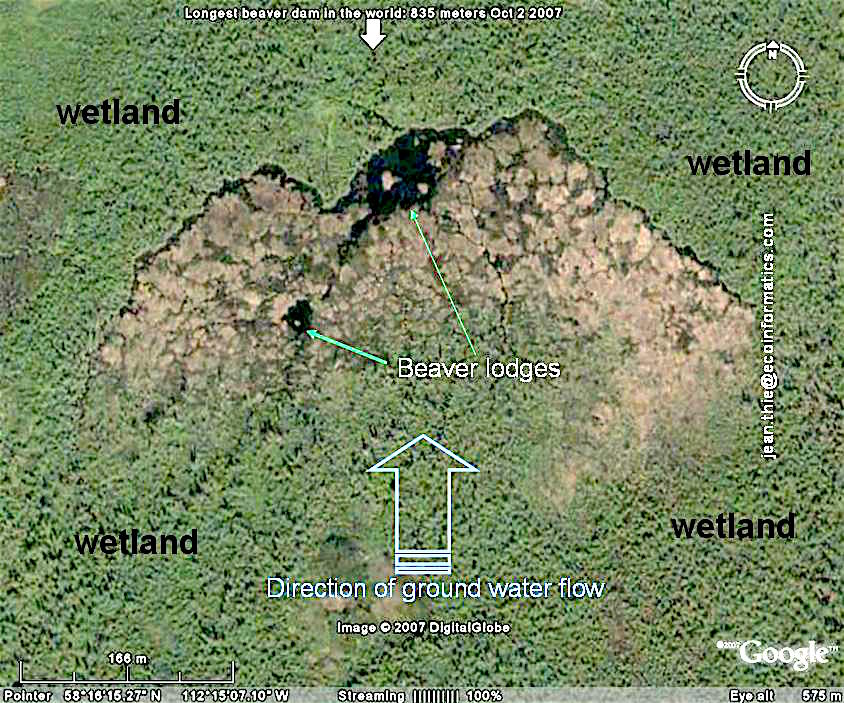
The dam is, apparently, about one and a half CN Towers in length, ~850 metres or 2,800 feet long. The product of several generations of beavers, the dam blows past the old record of a dam 652 metres long in Three Forks, Montana.
Beaver dams are unusual in that they can be seen from space--like the Great Wall or the Pyramids at Giza. Canadian ecologist Jean Thie said Wednesday he used satellite imagery and Google Earth software to locate the dam, which is about 850 meters (2,800 feet) long on the southern edge of Wood Buffalo National Park.
Beaver can cut down as many as 200 trees a year, and generally build dams between 10 and 100 metres long. When such dams are near human development, the dams are usually destroyed and the beavers caught and transported tolittle beaver penal colonies new areas away from humans. These beaver, well away from people, have been free to reshape the environment as they see fit.
The dam wasn't begun until after 1975, it was determined after comparisons between aerial photographs. But they've been *ahem* beavering away on the dam for decades. Currently, there are two new dams going up that look like they will eventually be connected to this dam, making a dam almost a full kilometre long.
Here's a Parks Canada video of the dam from the air:
There's a number of links, so I'll just include a link cluster here.
Parks Canada
Discovery News
EcoInformatics
The dam is, apparently, about one and a half CN Towers in length, ~850 metres or 2,800 feet long. The product of several generations of beavers, the dam blows past the old record of a dam 652 metres long in Three Forks, Montana.
Beaver dams are unusual in that they can be seen from space--like the Great Wall or the Pyramids at Giza. Canadian ecologist Jean Thie said Wednesday he used satellite imagery and Google Earth software to locate the dam, which is about 850 meters (2,800 feet) long on the southern edge of Wood Buffalo National Park.
Beaver can cut down as many as 200 trees a year, and generally build dams between 10 and 100 metres long. When such dams are near human development, the dams are usually destroyed and the beavers caught and transported to
The dam wasn't begun until after 1975, it was determined after comparisons between aerial photographs. But they've been *ahem* beavering away on the dam for decades. Currently, there are two new dams going up that look like they will eventually be connected to this dam, making a dam almost a full kilometre long.
Here's a Parks Canada video of the dam from the air:
There's a number of links, so I'll just include a link cluster here.
Parks Canada
Discovery News
EcoInformatics
Wednesday, April 21, 2010
Ever wonder...
...what our governments get up to? I do. And Google has decided to post just how many requests and of what kind governments are making of them. I applaud the transparency, even as I remain suspicious of Google's motives.


A screengrab from Firefox, cropped with GImP
Tuesday, December 01, 2009
The Biggest Threat to the World: Canada
George Monbiot's latest column from the Guardian, which focuses on Canada and the tar sands, deserves to be reprinted in full. We must do better than this, and that starts with politicians with vision and purpose, unlike what we have now on either side of The House.
When you think of Canada, which qualities come to mind? The world's peacekeeper, the friendly nation, a liberal counterweight to the harsher pieties of its southern neighbour, decent, civilised, fair, well-governed? Think again. This country's government is now behaving with all the sophistication of a chimpanzee's tea party. So amazingly destructive has Canada become, and so insistent have my Canadian friends been that I weigh into this fight, that I've broken my self-imposed ban on flying and come to Toronto.
So here I am, watching the astonishing spectacle of a beautiful, cultured nation turning itself into a corrupt petro-state. Canada is slipping down the development ladder, retreating from a complex, diverse economy towards dependence on a single primary resource, which happens to be the dirtiest commodity known to man. The price of this transition is the brutalisation of the country, and a government campaign against multilateralism as savage as any waged by George Bush.
Until now I believed that the nation that has done most to sabotage a new climate change agreement was the United States. I was wrong. The real villain is Canada. Unless we can stop it, the harm done by Canada in December 2009 will outweigh a century of good works.
In 2006 the new Canadian government announced it was abandoning its targets to cut greenhouse gases under the Kyoto protocol. No other country that had ratified the treaty has done this. Canada was meant to have cut emissions by 6% between 1990 and 2012. Instead they have already risen by 26%.
It is now clear that Canada will refuse to be sanctioned for abandoning its legal obligations. The Kyoto protocol can be enforced only through goodwill: countries must agree to accept punitive future obligations if they miss their current targets. But the future cut Canada has volunteered is smaller than that of any other rich nation. Never mind special measures; it won't accept even an equal share. The Canadian government is testing the international process to destruction and finding that it breaks all too easily. By demonstrating that climate sanctions aren't worth the paper they're written on, it threatens to render any treaty struck at Copenhagen void.
After giving the finger to Kyoto, Canada then set out to prevent the other nations striking a successor agreement. At the end of 2007, it singlehandedly blocked a Commonwealth resolution to support binding targets for industrialised nations. After the climate talks in Poland in December 2008, it won the Fossil of the Year award, presented by environmental groups to the country that had done most to disrupt the talks. The climate change performance index, which assesses the efforts of the world's 60 richest nations, was published in the same month. Saudi Arabia came 60th. Canada came 59th.
In June this year the media obtained Canadian briefing documents which showed the government was scheming to divide the Europeans. During the meeting in Bangkok in October, almost the entire developing world bloc walked out when the Canadian delegate was speaking, as they were so revolted by his bullying. Last week the Commonwealth heads of government battled for hours (and eventually won) against Canada's obstructions. A concerted campaign has now begun to expel Canada from the Commonwealth.
In Copenhagen next week, this country will do everything in its power to wreck the talks. The rest of the world must do everything in its power to stop it. But such is the fragile nature of climate agreements that one rich nation – especially a member of the G8, the Commonwealth and the Kyoto group of industrialised countries – could scupper the treaty. Canada now threatens the wellbeing of the world.
Why? There's a simple answer: Canada is developing the world's second largest reserve of oil. Did I say oil? It's actually a filthy mixture of bitumen, sand, heavy metals and toxic organic chemicals. The tar sands, most of which occur in Alberta, are being extracted by the biggest opencast mining operation on earth. An area the size of England, comprising pristine forests and marshes, will be be dug up – unless the Canadians can stop this madness. Already it looks like a scene from the end of the world: the strip-miners are creating a churned black hell on an unimaginable scale.
To extract oil from this mess, it needs to be heated and washed. Three barrels of water are used to process one barrel of oil. The contaminated water is held in vast tailings ponds, some so toxic that the tar companies employ people to scoop dead birds off the surface. Most are unlined. They leak organic poisons, arsenic and mercury into the rivers. The First Nations people living downstream have developed a range of exotic cancers and auto-immune diseases.
Refining tar sands requires two to three times as much energy as refining crude oil. The companies exploiting them burn enough natural gas to heat six million homes. Alberta's tar sands operation is the world's biggest single industrial source of carbon emissions. By 2020, if the current growth continues, it will produce more greenhouse gases than Ireland or Denmark. Already, thanks in part to the tar mining, Canadians have almost the highest per capita emissions on earth, and the stripping of Alberta has scarcely begun.
Canada hasn't acted alone. The biggest leaseholder in the tar sands is Shell, a company that has spent millions persuading the public that it respects the environment. The other great greenwasher, BP, initially decided to stay out of tar. Now it has invested in plants built to process it. The British bank RBS, 70% of which belongs to you and me (the government's share will soon rise to 84%), has lent or underwritten £8bn for mining the tar sands.
The purpose of Canada's assault on the international talks is to protect this industry. This is not a poor nation. It does not depend for its economic survival on exploiting this resource. But the tar barons of Alberta have been able to hold the whole country to ransom. They have captured Canada's politics and are turning this lovely country into a cruel and thuggish place.
Canada is a cultured, peaceful nation, which every so often allows a band of Neanderthals to trample over it. Timber firms were licensed to log the old-growth forest in Clayaquot Sound; fishing companies were permitted to destroy the Grand Banks: in both cases these get-rich-quick schemes impoverished Canada and its reputation. But this is much worse, as it affects the whole world. The government's scheming at the climate talks is doing for its national image what whaling has done for Japan.
I will not pretend that this country is the only obstacle to an agreement at Copenhagen. But it is the major one. It feels odd to be writing this. The immediate threat to the global effort to sustain a peaceful and stable world comes not from Saudi Arabia or Iran or China. It comes from Canada. How could that be true?
Wednesday, November 11, 2009
Peak Oil
According to The Guardian:

The world is much closer to running out of oil than official estimates admit, according to a whistleblower at the International Energy Agency who claims it has been deliberately underplaying a looming shortage for fear of triggering panic buying.
The senior official claims the US has played an influential role in encouraging the watchdog to underplay the rate of decline from existing oil fields while overplaying the chances of finding new reserves.
The allegations raise serious questions about the accuracy of the organisation's latest World Energy Outlook on oil demand and supply to be published tomorrow – which is used by the British and many other governments to help guide their wider energy and climate change policies.
Listen to an audio clip with Terry Macalister here.
A report by the UK Energy Research Council (UKERC) said worldwide production of conventionally extracted oil could "peak" and go into terminal decline before 2020.
The world has used less than half of the planet's conventionally extracted oil, but the remaining resources will be more difficult and expensive to get out of the ground, slowing production and increasing prices of crude.
With exploitation of the world's reserves running at more than 80m barrels a day, even major new discoveries such as the oil fields recently found in the Gulf of Mexico by BP would only delay a peak by a few days or weeks, the report said as reported by The Guardian.
The report, from the Peak Oil group, warns that the problem of declining availability of oil will hit the UK earlier than generally expected - possibly within the next five years and as early as 2011. [Also reported in The Guardian]
We don't have any plans in place to deal with peak oil: in Canada, we import the oil we use, and export the oil we produce (leaving most of us feeling WTF?). We peak out, everything falls apart. Our government is in denial, our corporate heads seem to be suffering a complete meltdown,and the general public just doesn't want to know. Any wonder why I'm a bit despairing of our future?
Powered by ScribeFire.
Thursday, October 29, 2009
Canada and the World
Even 20 months ago, no one knew what 350 meant, nor why it mattered. That's less than 2 years back. Then 10,000 year old ice sheets disappeared in the Arctic, Stephen Harper got a north of 60 hard-on, the IPCC released a report based on data that was already out of date (some of it a decade out of date), and a book detailing how James Hansen's work was censored came out. We shook our collective head, and some of us began to realize that we had entered what James Kunstler has called The Long Emergency.
It didn't take long to realize that 350 was the upper limit of atmospheric CO2 that could be considered "safe" (meaning that we might be able to keep global warming to 2°C and we might be able to live with the consequences of that rise), and here we are today looking at 390 ppm of carbon dioxide, no significant efforts being made to reduce carbon emissions, and a future that's looking at a minimum of 4°C warming and 6 metres of sea level rise--meanwhile emissions continue to increase and atmospheric CO2 rises at about 2ppm/year.
Here in Canada, we've got a Conservative government that is lead by a Prime Minister who still yet to convince anyone that he actually believes global warming may be a problem. Stephen "American Corporate Lackey" Harper is busy fiddling while the globe--including the nation of which he is nominally a member--burns. All our divorced-from-reality leader can see is the NorthWest Passage opening up and all that lovely ocean open to commercial exploitation.
Last week, the British Meteorological Office released a map of what we can expect to happen when we hit 4°C. The equatorial countries will get hotter, true, but the further you get from the equator, the more extreme the changes. But even now, Environment Minister Jim Prentice wants special treatment for Canada, allowing us--well, really just Alberta and the oil sands--to continue increasing our GHG emissions, while insisting that developing nations like China and India agree to hard caps that we ourselves will not accept. And the Canadian Government still refuses to release specifics of its plan to reduce our GHG emissions by 20% from our 2006 levels--which is light-years from our commitment under Kyoto.
Today comes the release of a new report. Quite unlike anything released in Canada before, it was financed by the Toronto Dominion Bank, produced by the Pembina Institute and the David Suzuki Foundation, with economic modeling by the well-respected economic consultants, M.K. Jaccard and Associates Inc. As John Ibbitson writes in the Globe and Mail; "A major bank has paid two environmental organizations to produce a groundbreaking report that, for the first time, calculates the costs of both the Harper government's modest plans to reduce greenhouse-gas emissions and the much more ambitious targets set by the environmental community, nationally and regionally."
The report offers a regional breakdown of economic impacts based on both the Harper government's vague commitment to 20% by 2020 (from 2006 levels) and the impact from the deeper and harder cuts that environmentalists are calling for and that would put Canada in line with our international obligations. And guess what? Neither scenario would kill us!
According to the report,"The Conservative government's goal of reducing greenhouse-gas emissions by 20 per cent by 2020 can be achieved, but only by limiting growth in Alberta and Saskatchewan." Alberta's growth would be 8.5% less in 2020 than it would be under a BAU (Business As Usual) approach, the report concludes. Under the same scenario, Saskatchewan would lose 2.8% of its projected growth. Central Canada, on the other hand, might well see some additional growth added to its projection. To quote Shawn McCarthy's article in the G&M; "Despite the steep costs involved in meeting targets, the analysis concludes the Canadian economy would continue to grow, albeit at a slower pace, and that investment in renewable energy and efficiency measures would result in an overall increase in employment compared to a “business-as-usual” scenario.
And even with the significant reduction in Alberta's potential growth and employment prospects, the province would still lead the country economically over the next 10 years."
So our economy would continue to grow AND there would probably be an increase in employment as well. And the cost? A reduction in projected growth an Alberta and Saskatchewan, and a significant out-migration from both provinces back to central Canada.
To further quote Shawn McCarthy's article: "TD's chief economist, Don Drummond, said the bank has not endorsed any targets, though it has supported a policy of a national emissions cap. He said the bank's interest was to shed light on an area where there has been little informed debate: the likely cost of imposing regulations."
I'm actually not seeing any real downside here. The Globe and Mail editorial board does though. In today's editorial, we read: "[T]he study acknowledges that what is proposed is no less than an economic upheaval: “There is a migration of capital and labour out of carbon and trade exposed sectors (e.g., fossil fuels) to sectors that are less carbon and trade exposed (e.g., manufacturing, services and renewable electricity).”
Canada cannot take its national unity for granted and must not, in the service of international obligations, allow itself to be immolated by a government policy of such wrenching dislocation." And the editorial concludes: "[T]he target [of carbon dioxide emission reduction] may be unreachable without unacceptable damage to Canada's economy and national unity. In which case, it is time for new targets, and new policies."
I can't help but think that no-one raised much of a stink about the "wrenching dislocation" caused by the development of the oil sands on the communities of Atlantic Canada. And even Jeffrey Simpson concludes that the Harper government's targets are just so much smoke being blown up our collective asses.
And so we have serious economic modelling of the potential and problems with trying to meet our international obligations regarding global warming and CO2 emissions. And we can now point to the report and say, "Tough, yes. But it won't kill us, and will probably make us stronger." And what of the complaints sure to come from the political and ruling classes of Alberta and Saskatchewan? Well, both provinces have had a great decade, with both provinces posting significant surpluses in their budgets, and neither has done a damn thing to prepare for the inevitable crash (particularly Alberta under Ralph Klein). For Alberta, that's two oil-based booms they've pissed away under Conservative governments. So honestly, I have no great sympathy for the Alberta government. And regardless of any future whining, we can look at the economic model contained in the M.K. Jaccard and Associates Inc. report, and read again the conclusion that "even with the significant reduction in Alberta's potential growth and employment prospects, the province would still lead the country economically over the next 10 years." And the planet (well, the human part of it) would thank us for facing up to our responsibilities.
Powered by ScribeFire.
Tuesday, October 27, 2009
Copenhagen, Canada, and the End of the World
The Globe and Mail is reporting on an interview with Environment Minister Jim Prentice, saying that the chance of an agreement on climate change in Copenhagen is pretty much non-existent.
The world wants a climate change agreement in Copenhagen. The US is even onside, with President Obama actually understanding both the science and political realities of global warming. The EU wants an agreement, with Germany busy poaching Canadian alternative energy companies and the Brits launching the 10-10 campaign. China is even pursuing lower carbon emissions. So what's the problem?
The problem is the Canadian government. Canada has become the biggest roadblock to an international agreement to lower carbon emissions. According the the G&M article (23 October 2009, p A1 Ottawa dashes hope for treaty in Copenhagen) Canada is continuing to "insist that it should have a less aggressive target for emission reductions[...] because of its faster-growing population and energy-intensive industrial structure". The Harper government is also going to insist that any cap on industrial emissions will not be applied uniformly across the country, but will allow the Alberta oil sands to continue expanding. To quote the Environment Minister; "The Canadian approach has to reflect the diversity of the country and the sheer size of the country, and the very different economic characteristics and industrial structure across the country." The Harper government has also demanded that emerging economies (like China and India) agree to binding caps on carbon emissions, and has refused to release its own plan for carbon reduction until there is clarity on what the Americans are planning to do.
The New Democratic Party has a bill currently in committee that would commit Canada to an emission reduction of 25% from 1990 levels by 2020--a target that would meet our commitment under Kyoto and would be consistent with the EU's approach in the next round of negotiations. Ottawa has proposed a reduction of 20% from 2006 levels of emissions by 2020--our obligation under Kyoto was a cut of 6% from 1990 levels by 2012. The plan proposed by the Harper government would result in a 3% reduction from 1990 levels by 2020. Chief climate negotiator Michael Martin said to the committee considering the NDP bill that the Harper government's targets are "comparable" because they will be just as costly to achieve as the more aggressive NDP targets.
What becomes clear, as we follow the progress towards significant carbon emission reductions, is that the Harper government has no intention of ever reducing carbon emissions. Harper simply does not consider carbon emissions to be a problem (how can I say that? By simply looking at his record).
And our Prime Minister is dragging a lot of sceptics along with him. World-wide, temperatures maxed out in 1998, leading deniers to claim that temperatures have levelled off or are even declining. But new research to be published in Geophysical Research Letters, was carried out by Judith Lean, of the US Naval Research Laboratory, and David Rind, of Nasa's Goddard Institute for Space Studies. The research, "is the first to assess the combined impact on global temperature of four factors: human influences such as CO2 and aerosol emissions; heating from the sun; volcanic activity and the El Niño southern oscillation, the phenomenon by which the Pacific Ocean flips between warmer and cooler states every few years.
The analysis shows the relative stability in global temperatures in the last seven years is explained primarily by the decline in incoming sunlight associated with the downward phase of the 11-year solar cycle, together with a lack of strong El Niño events. These trends have masked the warming caused by CO2 and other greenhouse gases.
As solar activity picks up again in the coming years, the research suggests, temperatures will shoot up at 150% of the rate predicted by the UN's Intergovernmental Panel on Climate Change. Lean and Rind's research also sheds light on the extreme average temperature in 1998. The paper confirms that the temperature spike that year was caused primarily by a very strong El Niño episode. A future episode could be expected to create a spike of equivalent magnitude on top of an even higher baseline, thus shattering the 1998 record.
The study comes within days of announcements from climatologists that the world is entering a new El Niño warm spell. This suggests that temperature rises in the next year could be even more marked than Lean and Rind's paper suggests." (The Guardian Online).
The British Meteorological Office released a new map of the world (below) showing the current thinking on what the world will look like with a 4°C rise in the average global temperature. The 4°C rise mostly happens at the equator--the further you move away from the equator, the greater the changes. Here on Vancouver Island, we may only see an average 5°C rise, but up in Hudson's Bay, its looking more like 16°C. What this doesn't indicate is just how this will affect global weather patterns. If it was just going to get warmer, that wouldn't be the end of the world.But all that extra energy is going to change things in ways we can't imagine yet, much less model.
The Met Office says that climate researchers have discovered that:
- levels of CO2 have risen 40% since the Industrial Revolution
- Global sea levels have risen 10cm in the last 50 years [and that's a hell of a lot of water]
- temperatures in the Arctic have risen at twice the global average [which suits our Prime Minister just fine]
- snow cover in the northern hemisphere has dropped 5% in the last 2 decades
Thursday, October 22, 2009
Ah, I Can Feel It Working
From over at IPS:
In recent weeks, Greenpeace has staged three daring protests inside tar sands mines, temporarily shutting down parts of the world's largest energy project. On Oct. 3 and 4, activists blocked construction of an upgrader needed to refine heavy tar sands oil, belonging to Shell in Ft. Saskatchewan, Alberta.
Civil disobedience from Greenpeace, leading to 37 arrests, has enraged Alberta's conservative government. "We're coddling people who are breaking the law," complained Premier Ed Stelmach during a media scrum in early October.
"Premier Stelmach's public suggestion that he will use the 'force of the law to deal with these people' confirms his lack of knowledge of the limits of his authority and the clear rule that our system of justice cannot be interfered with or manipulated for political reasons," responded Brian Beresh, the defence lawyer representing arrested activists, at a news conference in Edmonton.
This is one of the uses of civil disobedience--like one of the uses of terrorism--to provoke those in power into over-reacting and doing something stupid that makes the instigator's point for them. Like the US after 9-11 made Al Qaeda's point that they were an imperial power by invading Iraq, the Alberta government is going to make Greenpeace's point for them. They are actually threatening to use anti-terrorism legislation to shut down civil disobedience at the tar sands.
"Canada's tar sands will singlehandedly produce more greenhouse gas emissions than Denmark, Ireland, Austria or Portugal by 2020 if the development continues expanding at its current rate, according to a recent report written by award-winning business reporter Andrew Nikiforuk. The tar sands already spew more greenhouse gas emissions than Estonia or Lithuania", the article continues.
It's not like Greenpeace stands alone on this; the head of the IPCC has also said that the tar sands should be shut down.
Keep in mind that this Saturday--October 24th--is 350 day, the international day of climate action. The 350 refers to the accepted maximum concentration of CO2 in Earth's atmosphere--the number we've blown past already. Last I checked, we were at 385. Write an MP, get out and be counted, ride a bike, whatever. Check the website for ideas. In Victoria, there will be a day of activities at Centennial Square on Saturday.
Powered by ScribeFire.
Friday, March 06, 2009
Explain it to me....
I'm becoming increasingly frustrated watching the massive bailouts to the auto industry etc. It just so damned wrong-headed. Forget the basic tenants of the free market which these same corporations preach whenever environmentalists or etc complain about their rapacious capitalism; forget about the fact that we're using tax payer money for private profit; forget that these welfare bums are demanding gobs of cash in return for nothing -- I'd be much more okay with handing over the cash to preserve a national presence in auto manufacturing IF in return the citizens get a couple of billion shares in the corporation (wasn't American built on the principle of 'no taxation without representation'?) -- forget all that. My problem is that we're propping up an industry whose time is over.
Why are we throwing gazillions into industry when we're a post-industrial society. John Bell explained this back in the 1970s, for heaven's sake. They're worried about saving jobs in a manufacturing industry, but the number of workers in the arts is significantly higher, and the jobs are more enjoyable, self-fulling, life-affirming, non-polluting, renewable resource -- why is no one trying to bail out the arts? Why do we think we need people to buy cars (polluting, global warming, road building tax drains that kill or maim thousands of drivers and pedestrians each month) but buying theater tickets or building art galleries is somehow wasteful. And talk about (as Harper did) art gallas -- but the car execs don't have galas, they have private jets; bankers have to have their salaries capped at $500,000 (not counting, if you read the fine print, stock options). We can't afford $10,000 grant to a Canadian magazine but we can give billions to auto manufacturing? To save a dying industry? The backwards looking boobies who have no vision and no leadership are trying to drive the ship of state in reverse. Let's go back to 1950, they seem to say, instead of figuring out how to aim for 2050. Might as well try to bail out blacksmiths and wheelwrights.
And wasn't the whole point of the exercise to save jobs? So how is it that these companies can lay off 35,000 workers at a go, AND still take the bailout money. If they aren't even going to preserve jobs (other than the execs who created the problems) what was the point of forking over the cash?
Let us instead look to Sweden. When GM went had in hand and demanded huge bailouts for Saab, the governments response was, why? If you're in trouble, it's because your cars suck. We can let you access some funds for R&D to design the transport of the future, but building more of the current model, not so much. Furthermore, what money we have is going into nursery schools, because that is our future competitive edge; and into elder care, because that is a massive growth industry, and because those citizens built what we have to day. In contrast to your executives, who screwed up a perfectly good car company when you bought it out. So get out.
The Sweds are putting their bailout money into the non-profit sector because it is the largest employer - many many times larger in Sweden and Canada than industry. And since most people in the non-profit sector work for a LOT less than autoworkers we can hire two or three nonprofit people for every autoworker laid off. And they are more interesting, rewarding, and socially necessary jobs. Hell, for the price of one executive, we could fund an entire town's worth of programs! The Sweds get this, and they are not going to have recession or unemployment to the same extent because there's tons of room to expand nonprofit -- no contracting market there.
Who do you think will be ahead economically in ten years? 50 years? Sweden or... will there even been a Canada in 50 years?
Thursday, January 29, 2009

Thursday, December 04, 2008
Groundhog Day
So the Governor General looked out her window this morning and saw her shadow.
That means at least six more weeks of a Harper government.
That means at least six more weeks of a Harper government.
Wednesday, December 03, 2008
Notes From a Constitutional Crisis Zone
In our system of parliamentary democracy, we do not elect a government; we elect a parliament. The government is formed when a group of members of the parliament can demonstrate that they have the support of the majority of the members to carry on a legislative agenda: to govern.
When the government no longer has the support of the parliament, the government falls and is replaced. The creation of a coalition of opposition parties to defeat and replace a sitting government is not illegitimate; it's how our system is meant to operate.
What it is, of course, is highly unusual in Canadian politics. Nothing like this has been done in the memory of most living Canadians. That doesn't make it illegal.
Canadians did not give Harper's Conservatives a mandate to run the country single-handedly. Canadians may be willing to let Harper sit in the driver's seat for a while, but after two elections they sure don't seem willing to let him have the keys on his own. Harper has spent the last three years forming coalitions; in a minority situation, the survival of his government has depended on it. Not one piece of his legislation could have passed the house without at least some opposition members voting along with the government. Harper may not have formed a formal coalition as the opposition has now done, but every piece of government business he presented to the House necessitated the forming of an ad hoc coalition with one of more opposition parties.
Harper's mistake is the age-old mistake of hubris. With Dion a lame-duck leader of the weakened Liberals, Harper believed he could push through with his damaging agenda, using a crisis to push through ideologically-driven economic measures.
Harper's economic statement originally proposed a three-year ban on the right of civil servants to strike, limits on the ability of women to sue for pay equity and eliminated subsidies for political parties. How does denying pay equity for women help stave off the effects of the worldwide economic meltdown? It doesn't, of course. It's just classic neo-conservative tactics -- use every chance to propel your ideological agenda. It's not about the economy, stupid; it's about using the economy to score every little political point you can.
Harper follows every page of the neo-con text book. He says one thing, but does another. Fixed election dates, anyone? He spent two years (and millions of dollars) on an ad campaign deriding Stephan Dion with personal attacks before the election was even called, despite his previous campaign promises on returning civility to politics. He accuses Dion of sharing power with seperatists, yet he and his party suck up to them in Quebec every chance they get. They have to, because that's the only group where he will get any support from in Quebec. His party has a long history of courting with the seperatists; it was Brian Mulroney's inability to control the seperatists MP in his Tory ranks that resulted in the formation of the Bloc.
In his acceptance speech this year, he said we work with the other parties in the House, yet his first economic announcement includes the cutting of party subsidies. How is this going to return civility to the House? Or more importantly, how does this help stimulate the economy when opposition parties have to lay-off low-level party workers during a recession? This is just petty nastiness.
And he lies, of course. He lies when he says that the coalition agreement was not signed in front of Canadian flags because of the presence of the separatist party (a lie - there were two Canadian flags). He lies when says he would never enter deals to govern the country with separatists. He signed a deal with the BQ to do just that in 2004, and his predecessor Stockwell Day arranged one with the BQ in 2000.
When confronted with criticism, he and his lackeys do not confront the issues, instead they issue personalize attacks on the messenger. How many Harper ads did you hear during the last campaign attacked Dion the person, yet how few did you hear actually debating the merits of Dion's proposals and presenting alternatives?
The crisis here is one of a reckless leader over-reaching for his dubious goals. It is a crisis of agenda, not process. You may argue that the Liberal/NDP coalition (with Bloc support) is fraught with dangers, and it is. They have matches and there's a lot of gasoline pooled about. But even that does not make their proposed actions any less legitimate.
And I'll take that over a leader who gives every indication of his intention to burn down the progressive house that we Canadians have spent 141 years building.
Percentage of Canadians who did not vote for Harper's Conservatives in the 2008 election: 62.4%
Naomi Klein on Harper's "Crisis"
As seen at rabble.ca:
What I think is really amazing about this moment is whatever happens next - whether we end up with this coalition or not, we will have an extremely chastened Harper. So the attempted shock doctrine has failed. I think we can say that decisively.
Just to be clear, what I mean by the shock doctrine, as you know, is the use of crisis to push through unpopular pro-corporate policies. This bundling of a whole package of policies: denying the right of public sector workers to strike, the attack on public financing of political parties, with the economic program - that is what failed, and people were offended by the opportunism of it.
This is what so many of us were worried about during the election - the context of a Tory victory in an economic crisis, because we know that there is this pattern of using an economic crisis to push through policies that were nowhere during the campaign.
Monday, December 01, 2008
I'm so embarrassed....
Listening/reading/viewing the commentary on current developments in parliament, I am left banging my head against the wall at the apparent total ignorance of the vast majority of Canadians about how a parliamentary system works. Every time I hear/read/see someone calling the coming change of government/Prime Minister a "coup" or "undemocratic" or whatever, I can't help but thinking it an indictment not of the opposition parties, but of Social Studies teachers everywhere who failed to teach their students the fundamentals of how democracy works in this country.
I'm fully sympathetic to Conservative supporters who say, "darn, I never saw that coming!", just as they were understanding that I was disappointed that the Conservatives managed to hang on to another minority government (for a while anyway). We all have to put up with it when the majority vote against what we think is the obvious best policy. But to characterize current developments as undemocratic, or as a 'coup' or 'treason' is just, well, embarrassing.
The majority of us did not vote for Harper. He did NOT get the mandate from the people for a majority government that he had hoped for. Even then, he got his chance to form a minority government, but any minority government has to win over at least a few of the opposition MPs/parties each time to survive. Harper's mistaken belief that he could introduce any legislation he liked and that there was nothing anyone could do about it (because the other parties could not dare force another election) strongly suggests both an undemocratic stance (i.e., not valuing the fundamental Canadian value of compromise) and a dangerously arrogant/naive understanding of Canadian parliamentary procedure. But parliament is working exactly as intended. The majority of MPs, representing the majority of Canadians, are ousting a Prime Minister and cabinet that no longer hold the confidence of the House. This is how the system works, and has worked stretching back to before there was a Canada to British parliamentary precedents. How could anyone in this country graduate high school and not understand this?
It's embarrassing.
They don't have to like the way things have played out, but they should at least be able to understand it.
January I get a new crop of Social Studies student teachers -- and they had better, by god, be ready to demonstrate that they take Social Studies seriously, not just a way to kill an hour between English and Mathematics. They had better be prepared to stand up and say, "No, you can't cancel Social Studies this week for school assembly because Social Studies is important. Can we cancel Phys Ed instead?" Or words to that effect. Because right now, it doesn't look like the previous crops have been doing their job.
Friday, November 28, 2008
Quote of the Day
On Don Newman's CBC Newsworld show today, someone said:
In early October Harper said it would be a good time to buy into the market and if you'd listened to him you would all be bankrupt today.
Wednesday, November 12, 2008

Thursday, October 23, 2008
Wednesday, October 15, 2008
And We Spent $300,000,000 For What Exactly....?
2008 Voter Turnout:
59.1% of registered electors (or about 41% of all Canadians)
- one of the lowest in recent history
Total Conservative vote percentage:
2006 - 36.3%
2008 - 37.6%
- A 1.3% increase after governing for 2 years
- From 127 to 143 seats (gained 16 seats)
Percentage of Canadians who did not vote for Harper's Conservatives: 62.4%
Times Stephen Harper has attempted to get a majority and failed:
Three times (in 2004, 2006, and 2008)
Overall Seat Count 2008:
Conservatives: 143
Opposition: 163
Liberal vote percentage:
2006 - 30.2%
2008 - 26.2%
From 95 to 76 seats
NDP vote percentage:
2006 - 17.5%
2008 - 18.2%
From 30 to 37 seats
Bloc Québécois
2006 - 10.5% (Canada-wide)
2008 - 10% (Canada-wide)
From 48 to 50 seats
Green vote percentage:
2006 - 4.5%
2008 - 6.8%
No seats
Under a Proportional Representation system, the seat totals would have been:
Conservatives: 116
Liberal: 81
NDP: 56
BQ: 31
Green: 24
When a party like the BQ gets 10% of the vote and 16% of the seats, while the Greens get 7% of the vote and no seats, that clearly shows the flaws of the current first-past-the-post system.
All five party leaders have some thinking to do this morning. While many of them had a bright side to look at, none of them really got anything they wanted.
The Green's Elizabeth May got her wish: she was in the debate. The Greens increased their popular vote more than any other party. And were still nowhere near electing anyone. The Greens need a leader who will run for Prime Minister, not offer up advice on strategic voting.
Speaking of running for Prime Minster, that's what Jack Layton of the NDP did. He took dead aim at Harper's job. And finished fourth. Yes, the NDP did gain some seats, but how many more fight does Jack have in him?
Then there's Gilles Duceppe, The Man Who Would Not Be King. He's got to feel good. His party gained a couple of seats, and clearly his plea to Quebeckers to stop a Harper majority worked. It's too bad for him that all those voters who listened to him chose to block Harper by voting Liberal. How many more elections does Duceppe have in him? Can the Bloc survives if he leaves, or has it become irrelevant and does it survive only by the force of Duceppe's personality?
The only bright side to the Liberal's performance is that they did make some gains in Quebec, but otherwise it was a dismal show. Dion is toast. The knives are out. The Liberals need to make some big changes soon, or they will disappear has a force in Canadian politics. Who will be the next leader? I'm thinking Ignatieff. But the leader after him will have a familiar name: Trudeau.
Harper and the Conservatives had a reasonable night. But this is Harper's third time at the plate and he couldn't close the deal with a majority. And if he couldn't do it this time, with the center/left vote split three ways, an ineffective opposition leader, and an economist's perfect issue dropped into his lap in mid-campaign, can he ever? The knives may not be out yet for Harper, but I'm sure some Tories are going through the knife drawer.
Thursday, October 02, 2008
I've Said it Before....
...and I'll say it again:
If Gilles Duceppe would forget about sovereignty, run a national slate and change the name of the party to Bloc Canada, he'd get my vote.
If Gilles Duceppe would forget about sovereignty, run a national slate and change the name of the party to Bloc Canada, he'd get my vote.
Thursday, September 25, 2008
A New Word is Born
Electile Dysfunction:
The inability to become aroused over any of the choices for PRIME MINISTER put forth by any party in the 2008 election year.
The inability to become aroused over any of the choices for PRIME MINISTER put forth by any party in the 2008 election year.
Subscribe to:
Posts (Atom)